There’s a quiet frustration simmering in comic communities worldwide from Reddit threads to Discord servers to convention backrooms.
It’s not about art quality. It’s not about storytelling. It’s about something more uncomfortable:
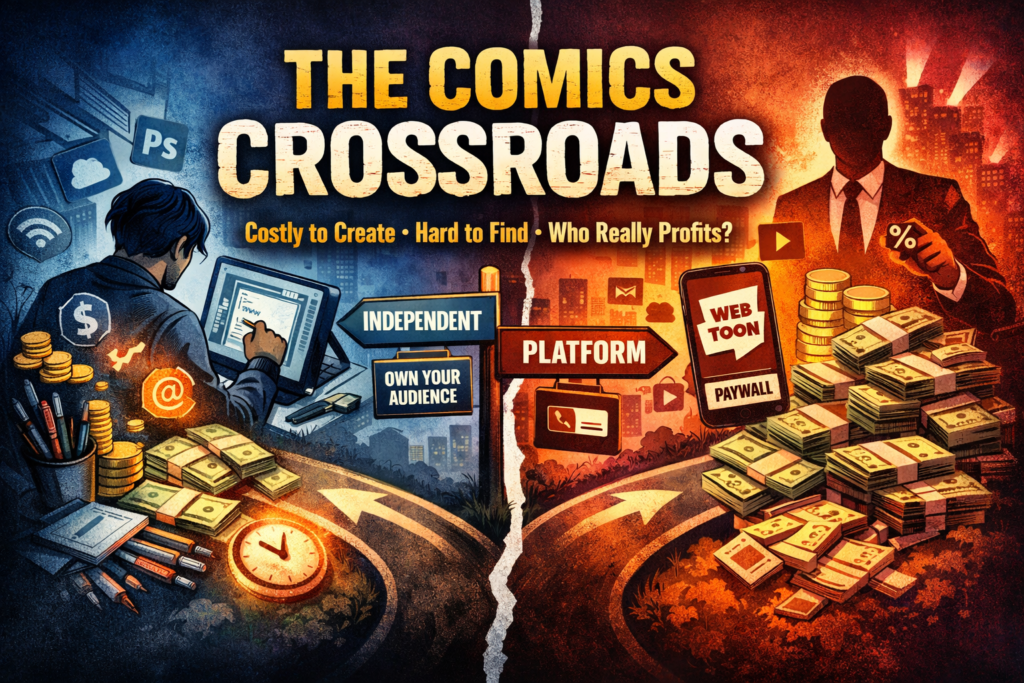
Comics are expensive to make. Hard to discover. And the platforms promising “exposure” may not be solving either problem.
This isn’t just an African issue. It’s global. And it’s getting louder.
The Real Cost of Making Comics
Let’s strip the glamour away.
Creating a comic especially independently isn’t cheap. Even if you draw and write everything yourself, you’re investing:
- Software subscriptions
- Drawing tablets or hardware
- Internet costs
- Marketing spend
- Hosting fees
- Time (the most expensive currency of all)
For creators who outsource lettering, coloring, editing, or development, the costs multiply fast.
Then comes printing, if you’re going physical paper, shipping, distribution cuts.
So here’s the tension: Readers want affordable or free content. Creators need sustainable income.
Some webtoon platforms promise to bridge that gap. But do they?
The Discoverability Illusion
This is where the debate gets controversial.
One Reddit creator put it bluntly:
“It might not be easy, but as artists, we need to start ditching webtoon curation platforms and similar companies, and take responsibility for marketing our own work.”
Harsh? Maybe.
But it taps into something real.
Most major webtoon platforms promote only a tiny percentage of their creators aggressively. A banner feature for a week. A homepage carousel. A “staff pick.” Then what?
After that spotlight fades, creators are often left doing the heavy lifting themselves pushing links on Instagram, running their own ads, building newsletters, engaging communities manually.
So the question becomes uncomfortable:
If creators are still doing most of the marketing… what exactly are platforms taking their cut for?
Exposure vs Ownership
Platforms sell convenience. Upload here. Gain readers. Monetize. Simple.
But convenience can quietly morph into dependency.
Creators on major platforms often:
- Don’t own their audience data
- Don’t control algorithm visibility
- Can lose reach overnight due to ranking shifts
- Surrender a significant revenue percentage
And yet, many of these platforms rarely run consistent, aggressive external advertising campaigns for individual indie creators.
You don’t see mass-market webtoon ads everywhere. Occasionally, yes but not at the scale their revenue cuts might suggest.
That’s why some creators are now asking:
If promotion is still our responsibility, shouldn’t ownership be ours too?
The Case for Going Independent
The alternative argument is bold and intimidating:
Build your own space.
Buy your own domain.
Host your own website.
Run your own ads.
Set up your own payment system.
Learn basic marketing.
At first glance, it sounds overwhelming. But here’s the uncomfortable truth:
If you can learn digital art, a skill that takes years to master you can learn basic SEO, social media funnels, and email marketing.
A small ad budget run strategically can outperform algorithm roulette. A mailing list you own is more powerful than 10,000 passive followers on a platform you don’t control.
And once your own site gains traction, the long-term margins are better. No massive platform cuts. No algorithmic invisibility.
Ownership builds leverage.
But Let’s Be Fair: Platforms Aren’t the Villain Either
Here’s where it gets nuanced.
Webtoon platforms do provide:
- Immediate infrastructure
- Built-in readership pools
- Monetization tools
- Global accessibility
- Lower barrier to entry
For many beginners, they’re the only realistic starting point.
Not every creator has the time, technical knowledge, or budget to build a full independent ecosystem from day one.
So the real issue isn’t platforms existing.
It’s over-reliance on them.
The Bigger Problem: Discoverability Is Broken Everywhere
Even outside webtoon platforms, discoverability is brutal.
Social media algorithms throttle reach.
Paid ads are getting more expensive.
Audiences are fragmented across platforms.
Free content dominates attention spans.
Creators aren’t just competing with other comics, they’re competing with TikTok, Netflix, YouTube, gaming, and everything else fighting for screen time.
So maybe the debate isn’t: “Are platforms exploiting creators?”
Maybe it’s: “Is discoverability fundamentally broken in the digital age?”
Accessibility vs Affordability
Here’s the core paradox:
- Readers want free or cheap comics.
- Creators need sustainable revenue.
- Platforms promise scale but take cuts.
- Independence promises control but requires heavy marketing effort.
Meanwhile, production costs continue rising.
The result? Creators feel squeezed from both sides.
Affordable for readers often means unsustainable for artists.
Sustainable for artists often feels expensive for readers.
That tension is not going away.
The Hard Truth: Marketing Is No Longer Optional
The romantic idea of “just make great art and you’ll be discovered” is outdated.
Today’s comic creator must also be:
- A brand builder
- A community manager
- A marketer
- A strategist
Uncomfortable? Yes.
Unfair? Maybe.
Reality? Absolutely.
The creators who thrive long-term aren’t just talented they understand funnels, retention, engagement, and ownership.
So… Should Creators Quit Platforms?
Not necessarily. But creators should ask harder questions:
- Are you building your audience, or renting one?
- If the platform disappears tomorrow, do you still have your readers?
- Are you learning marketing, or outsourcing your growth blindly?
- Is the revenue split justified by the value you’re receiving?
Convenience feels safe. Ownership feels scary.
But leverage lives in ownership.
The Industry Is at a Crossroads
The cost of comics is rising. Discoverability is chaotic. Platforms dominate distribution. Creators feel exploited. Readers expect free content.
Something has to shift.
Maybe the future isn’t fully independent.
Maybe it’s hybrid.
Platform + personal website.
Algorithm + email list.
Exposure + ownership.
But one thing is certain:
The era of passive creators is over.
If promotion is on you…
If branding is on you…
If audience-building is on you…
Then control should be on you too. And that’s where the real debate begins.