From comics and animation to gaming, Nigeria’s creative economy was largely built from the bottom up.
Now the President says the era of reform is giving way to an “age of prosperity” built around jobs, production, digital connectivity, enterprise and exports. The question for creatives is simple: how do we make sure we are part of that prosperity?
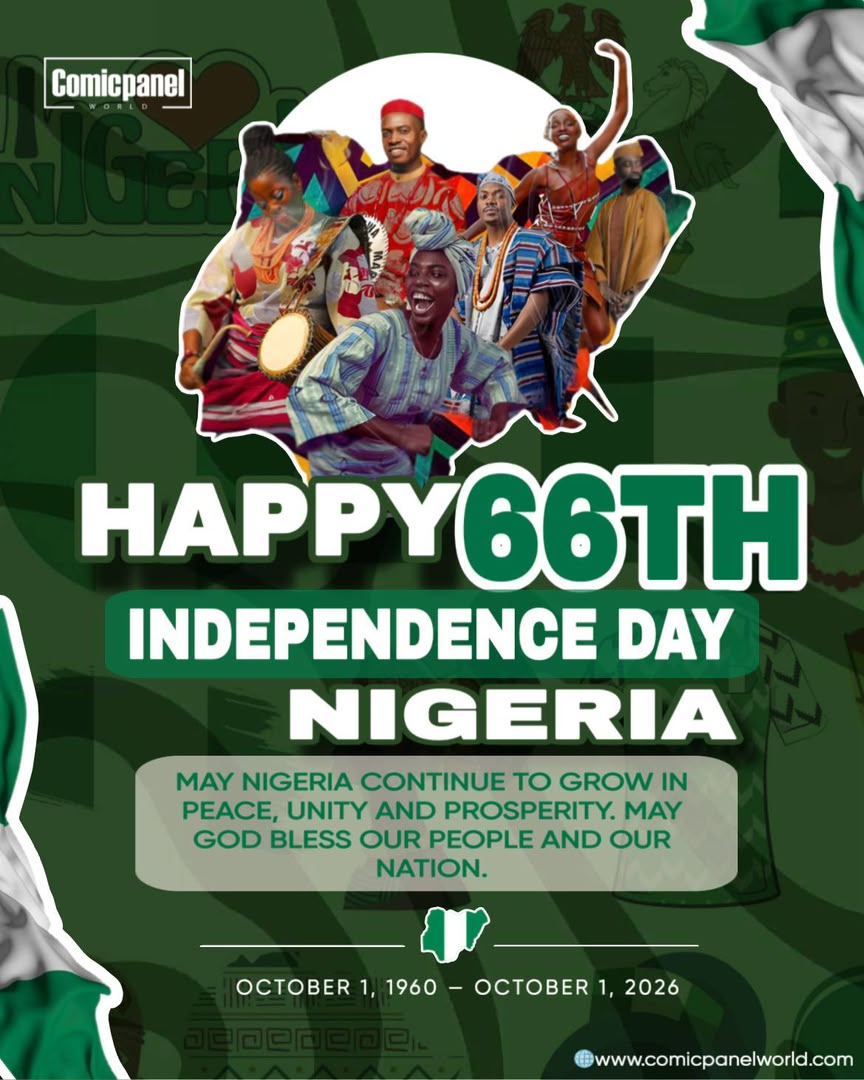
Nigeria turned 66 today.
And President Bola Ahmed Tinubu’s Independence Day address was, in many ways, a speech about what he believes Nigeria must become after three years of economic restructuring.
His message was clear: the difficult phase of reform is, in his telling, giving way to what he calls an “age of prosperity.”
He spoke about production. He spoke about jobs. He spoke about young Nigerians.
He spoke about digital connectivity. He spoke about businesses accessing finance. He spoke about Nigerian companies selling Nigerian products to the world.
He spoke about skills. He spoke about infrastructure. He spoke about investment. He spoke about exports. But there was something conspicuously missing.
He did not specifically mention Nigeria’s creative industry.
There was no dedicated reference to animation. No mention of comics. No mention of gaming.
No mention of Nollywood. No mention of music. No mention of fashion. No mention of intellectual property.
For an industry that the Federal Government itself now describes as an important component of economic diversification, that omission is worth examining.
Because if the President’s “age of prosperity” is genuinely about converting Nigerian talent into productive businesses, jobs and exports, then Nigeria’s creative sector should not be sitting outside that conversation.
It should be right in the middle of it.
And perhaps that is the most important message creatives can take from today’s speech as the industry begins planning for 2027.
The President’s Message Was Not Really About Oil
Tinubu’s address was fundamentally an economic speech.
The President argued that Nigeria has moved through the emergency phase of his administration’s reforms and should now concentrate on creating “shared and widespread prosperity.”
He pointed to economic growth, lower inflation from its peak, stronger foreign reserves, a more stable foreign-exchange market and more than $6 billion in non-oil export revenue in 2025.
Those are presidential claims about the state of the economy, rather than independent assessments contained within the speech, but they reveal what the administration wants Nigerians to focus on: production, diversification and the ability of Nigerian businesses to earn from the rest of the world.
That is where the creative industry enters the conversation.
Because an animation studio exporting a series is an exporter.
A Nigerian game studio selling a game internationally is an exporter.
A comic publisher licensing an African character abroad is an exporter.
A Nigerian illustrator working for an international publisher is exporting creative services.
A Nigerian animation studio producing a children’s series for an international broadcaster is participating in the same economic logic the President described.
The product simply happens to be intellectual property rather than crude oil, agricultural produce or manufactured goods.
That distinction matters.
The President Said Something Creatives Should Pay Attention To
One of the most revealing parts of the speech was his statement that he wants to see:
“more Nigerians making things.”
That sentence may have been directed primarily at manufacturing and agriculture, but it has enormous relevance to the creative economy.
Nigeria’s creative industry has been making things for decades.
Characters. Comics. Films. Music. Animation. Games. Fashion. Books.
Illustrations. Digital content. Design. Experiences. Stories.
The problem has rarely been the absence of Nigerian creativity.
The problem has been turning enough of that creativity into structured, scalable businesses that own valuable intellectual property and consistently sell into international markets.
That is a very different challenge.
And it may be the challenge Nigeria’s creative sector needs to confront in 2027.
The Next Phase Cannot Just Be “Creative Talent”
Nigeria already has talent.
The Federal Ministry of Arts, Culture, Tourism and the Creative Economy has itself acknowledged that the sector has historically thrived with inadequate government support.
Its current strategy includes the Creative Economy Development Fund, infrastructure initiatives, data collection and programmes aimed at skills and enterprise development.
The Ministry has also stated an ambition of roughly 2 million jobs from the creative sector by 2030 and says the sector currently contributes approximately 2.3% of GDP.
Those ambitions sound impressive.
But the question for 2027 should be:
How many globally competitive creative businesses are we actually building?
That is a much harder question.
Because ten thousand people being trained is not necessarily the same thing as ten thousand people earning sustainable incomes.
A thousand grants announced is not the same thing as a thousand businesses becoming profitable.
A creative hub is not automatically a creative economy.
And a government programme is not automatically an industry outcome.
The industry needs to start measuring the things that ultimately matter:
- Revenue generated.
- Jobs sustained.
- Intellectual property created.
- IP exported.
- International contracts won.
- Businesses that survive beyond one project.
- Private capital attracted.
- Royalties collected.
- Games launched.
- Animation produced.
- Comics published.
- Characters licensed.
- Studios that scale from five people to fifty.
Nigerian companies earning foreign exchange from creative services and IP. That is the language of the President’s new “prosperity” phase
The creative sector needs to speak it too.
Animation May Have The Biggest Opportunity If It Stops Being Seen Only As A Service
This is particularly important for Nigerian animation.
For years, much of the Nigerian animation ecosystem has been sustained by service work.
Brands commission animation.
Agencies commission animation.
International companies outsource animation.
Studios produce videos for clients.
There is nothing wrong with this.
In fact, service production is one of the ways an industry develops skills, creates jobs and builds production capacity.
But service work alone does not necessarily create substantial Nigerian-owned intellectual property.
The next stage is the combination of:
service + original IP + distribution + licensing + technology.
A Nigerian animation studio should ideally be able to survive client work while simultaneously developing characters, worlds and stories that it owns.
Those assets can eventually become television shows, films, games, comics, books, merchandise, educational products and licensing opportunities.
That is how animation begins to move from a production expense to an intellectual-property business.
And that is precisely where the government’s CEDF framework becomes potentially important.
The Ministry says the Creative Economy Development Fund is designed to provide financing to creative businesses and specifically identifies film, music, fashion, art, publishing, gaming and cultural tourism, while also proposing mechanisms through which intellectual property can be used as an asset in accessing finance.
For animation and comics, that idea could be transformative if implemented effectively.
A character should not merely be a drawing.
A character can be an asset.
A comic should not merely be a publication.
It can be an IP catalogue.
An animated series should not merely be a production.
It can be an international licensing property.
A game should not merely be an app.
It can become an exportable entertainment franchise.
Gaming Should Be Watching This Speech Very Closely
The gaming industry may be one of the clearest places where the President’s language around digital infrastructure, young people, skills and exports intersects with creative production.
The Nigerian Investment Promotion Commission currently identifies animation, gaming and extended reality among the country’s creative-economy investment opportunities.
But gaming requires more than talented developers.
It needs payment infrastructure.
Internet access.
Cloud infrastructure.
Hardware.
Training.
Investment.
Publishing.
Distribution.
IP protection.
International partnerships.
And access to global markets.
Those are precisely the kinds of structural issues that sit behind the President’s broader promise of a more digitally connected and productive Nigeria.
The administration has previously described digital infrastructure as essential to commerce, innovation and national productivity and has specifically included creative industries among sectors in which it says it is expanding opportunities for young Nigerians.
For gaming companies, therefore, the 2027 question should not simply be:
“Will government give us grants?”
It should be:
“Can government help create the environment in which Nigerian game companies can scale?”
Those are two very different propositions.
Comics Have An Even More Interesting Role
Comics are frequently treated as the smallest sibling of Nigeria’s entertainment economy.
That is partly because comics have historically had a weaker commercial infrastructure than music and film.
But economically, comics sit at the beginning of one of the most valuable chains in the creative economy:
story → character → IP → publishing → animation → gaming → merchandise → licensing.
That means the comic book can be more than a publication.
It can be an IP development laboratory.
A Nigerian comic creator who develops a compelling character is potentially creating the underlying intellectual property for several future industries.
This is why government policy that focuses exclusively on finished films, concerts or cultural festivals risks missing part of the creative economy.
Some of the most valuable creative assets begin very small.
Sometimes they begin as a sketch.
Sometimes as a comic.
Sometimes as a game prototype.
Sometimes as a short animation made by three people in a bedroom.
The policy question is therefore not simply:
“How do we fund entertainment?”
It should be:
“How do we help Nigerian intellectual property move from idea to globally monetised asset?”
There is Already a Government Architecture. Now Comes The Hard Part.
The Tinubu administration has created a Ministry specifically responsible for Arts, Culture, Tourism and the Creative Economy.
The Ministry has launched or promoted programmes including the Creative Economy Development Fund, Creative Leap Acceleration Programme, Destination 2030, the D30 data platform and other cultural and creative initiatives.
The Nigerian Copyright Commission also operates under a strengthened Copyright Act that provides a modern legal framework for digital rights, enforcement and copyright protection.
And there are signs of increasing private-sector interest.
In September, the Presidency announced that Vincent Bolloré’s business interests, including Canal+, MultiChoice and Universal Music Group, had discussed deeper localisation of operations in Nigeria across film, entertainment and fibre-optic infrastructure.
That is important. Because government does not have to become the producer of Nigerian entertainment.
Its more important role may be to make Nigeria a place where private capital finds creative businesses worth investing in.
The Real Test: Can Government Move From Programmes To Outcomes?
This is where the creative industry should become more demanding.
The Ministry has published ambitious targets.
The President has now declared that the country is moving into an era focused on prosperity.
The question is therefore no longer whether government understands that creativity has economic value.
The question is whether that understanding will produce measurable outcomes.
The industry should be asking for public scorecards.
For example:
CEDF
How much money has actually reached creative businesses?
How many animation studios, game companies, publishers and other creative businesses have benefited?
How much private capital followed the public investment?
How many jobs were created and retained?
What percentage of funded businesses remain operational after two or three years?
IP
How many Nigerian-owned IPs have been created?
How many have secured international distribution?
How many have generated licensing revenue?
EXPORTS
How much foreign exchange did Nigeria’s creative industries generate?
How many Nigerian creative companies exported services?
How many Nigerian-owned films, games, animation projects, books or characters entered international markets?
SKILLS
How many people trained through government programmes actually obtained employment or started sustainable businesses?
INFRASTRUCTURE
How many studios, creative hubs and production facilities are operational?
How many creatives can actually access them?
DATA
What does the D30 platform ultimately tell us about the sector?
And, crucially, what government decisions will be based on that data?
These questions are not anti-government.
They are what an industry serious about economic growth should ask.
2027 Should Be The Year The Creative Industry Stops Waiting
Perhaps the biggest lesson from Tinubu’s speech is not actually about government.
It is about the private sector. The President repeatedly framed the next phase around businesses, production, jobs, skills, exports and investment.
That means Nigerian creative companies need to prepare for an economy in which they are expected to behave less like informal creative collectives and more like scalable businesses.
For 2027, that means a studio should know its revenue.
It’s margins. It’s cost of production. It’s IP portfolio.
It’s clients.
It’s export potential.
It’s workforce.
It’s intellectual-property rights.
Its five-year pipeline.
Its financing requirements.
Its distribution strategy.
Its international markets.
And its measurable contribution to employment.
The era when simply being “creative” was enough is disappearing.
The global creative economy is becoming increasingly competitive.
Nigeria is no longer competing only with another Nigerian studio.
A Lagos animation studio can be competing with a studio in Johannesburg, Accra, Nairobi, Paris, Mumbai, Seoul or Los Angeles for the same contract.
A Nigerian game developer is competing globally.
A Nigerian comic creator can reach a global audience but is also competing globally for that audience.
That is the reality of the prosperity economy the President described.
So What Should The Creative Industry Do In 2027?
The industry should build its own agenda rather than wait for government to hand it one.
1. Build export-ready companies
Studios should identify the services and IP that can generate foreign revenue.
The target should not simply be “more clients.”
It should be more international clients and more international markets.
2. Treat IP as an asset
Creators need to document, register, protect and manage their intellectual property.
The Copyright Commission’s digital registration and enforcement infrastructure gives creators tools to begin doing this more systematically.
3. Develop original African IP
Animation studios, comic publishers and game developers should build original Nigerian and African properties alongside commercial service work.
4. Demand transparent financing
If public financing is made available, the industry should demand transparent eligibility criteria, application processes, disbursement figures and impact reporting.
5. Build industry data
The creative sector cannot keep arguing for billions of naira while struggling to answer basic questions about its own size.
How many studios exist?
How many people do they employ?
How much do they export?
How much revenue does animation generate?
What is the size of the Nigerian games market?
How many publishers exist?
How much Nigerian IP is being licensed internationally?
The industry needs answers.
6. Connect comics, animation and gaming
Nigeria should stop thinking of these as completely separate industries.
A successful comic can become animation.
Animation can become a game.
A game can generate characters.
Characters can become merchandise.
All of it can feed back into publishing.
This is the IP ecosystem Nigeria should be building.
7. Make private investment easier
The government cannot fund every creative company.
The objective should be to create conditions where banks, investors, pension-linked capital, international studios, distributors and technology companies can participate.
8. Build stronger international partnerships
The recent discussions involving the Presidency and Bolloré’s interests demonstrate that international companies are already looking at Nigeria’s cultural and digital market.
The industry should be prepared when those doors open.
9. Measure jobs differently
A training programme producing certificates is not necessarily an employment programme.
The industry should measure sustainable creative employment, income and business survival.
10. Create a 2027 Creative Industry Scorecard
This may be the most important one.
By this time next year, the Nigerian creative industry should be able to ask government:
What changed?
Not:
“What did you announce?”
Not:
“What did you promise?”
But:
What changed?
And What Does Tinubu’s Speech Really Mean For Creatives?
The speech should not be interpreted as a new creative-industry policy statement.
It wasn’t.
It was a broad economic address.
But it does establish the economic vocabulary that government says will define the next phase of the administration:
production.
jobs.
skills.
digitalisation.
enterprise.
investment.
exports.
infrastructure.
Those are all creative-industry issues.
The opportunity for Nigerian creatives is to make sure the government cannot discuss any of those subjects without including the creative economy in the room.
Because Nigeria’s creative industry is already producing.
It is already exporting culture.
It is already creating jobs.
It is already attracting international attention.
It is already producing globally recognisable music, film, fashion and stories.
The unresolved question is whether Nigeria can build the financial, legal, digital and industrial infrastructure necessary to capture a much larger share of the economic value those creative assets generate.
That is the real 2027 conversation.
Nigeria’s Creative Industry Has To Come Of Age Too
At 66, Nigeria is being asked to move from reform to prosperity.
The creative industry should take that challenge personally not politically, but economically.
For years, Nigerian creatives have demonstrated that they can create with very little.
They have built animation studios without serious institutional financing.
They have created comics without a functioning publishing ecosystem.
They have developed games with limited infrastructure.
They have made films with shoestring budgets.
They have taken Nigerian music to stadiums around the world.
They did much of this before the phrase “creative economy” became a central government policy expression.
Now government is saying the economic environment is entering a new phase.
If that promise translates into better infrastructure, access to finance, stronger IP enforcement, digital connectivity, investment and export support, the creative industry stands to benefit significantly.
But creatives should not simply wait for that benefit.
They should organise for it.
They should measure it.
They should demand evidence of it.
And they should build businesses capable of taking advantage of it.
Because perhaps the most important lesson from the President’s Independence Day speech is this:
Nigeria’s next economic story will not be written only by government.
It will be written by the businesses, entrepreneurs, workers, inventors and creators who turn opportunity into something people can actually buy, use, export and build careers around.
The creative industry has already shown that it can create the culture.
The challenge for 2027 is to prove that it can capture more of the value.
And if the President’s promised “age of prosperity” is to mean anything to Nigeria’s creatives, that is where the conversation must begin.