Across Nigeria’s growing comic and illustration scene, a new generation of artists is redefining how local stories are told blending culture, sport, and visual storytelling in ways that feel both fresh and familiar.
One of the creatives at the center of that movement is Chinonso Wilfred, better known in creative circles as ArtsbyNonso.
An illustrator whose work spans fashion, tech, and independent storytelling, Nonso has steadily built a reputation for striking visuals and imaginative concepts.
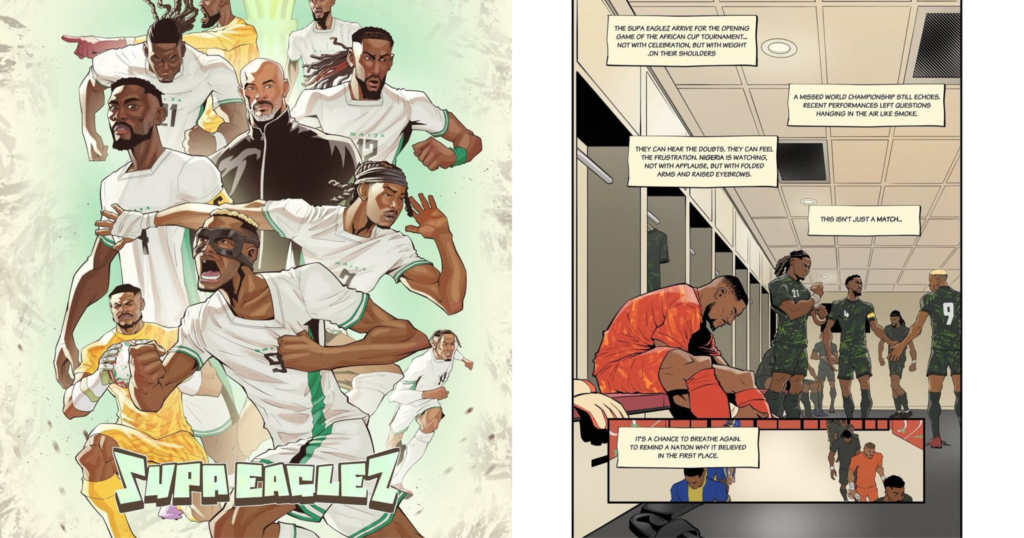
His latest project, Supa Eaglez, taps into something deeply Nigerian: the passion, drama, and emotional rollercoaster of football.
What began as a spontaneous idea during the Africa Cup of Nations quickly resonated with audiences online, proving that the intersection of sports and comics can spark powerful connections with fans.
In this exclusive conversation, ArtsbyNonso opens up about his early creative influences, the inspiration behind Supa Eaglez, navigating multiple creative roles, and his hopes for the future of the Nigerian comic industry.
Q: Can we get to know you? Who is Chinonso Wilfred beyond the name ArtsbyNonso your background, your roots, and how art first found you?
R: I’m from Imo State and I grew up in Owerri with my parents and four siblings. From a very young age, I always had a creative mind. I was that kid whose school notebooks had the back pages filled with drawings, and who would rip cartons apart just to build or construct things.
Thankfully, my parents noticed that early. My mom especially supported it, she would buy me sketchbooks and all kinds of pencils whenever I asked. Art wasn’t my only interest growing up though. Football was a big part of my life as well. I spent alot of time playing on the streets and I even had dreams of becoming a professional footballer at one point. But eventually, art won.
Q: Every creator has a defining moment. What was the turning point when you realized comics weren’t just a hobby, but something you could build a future around?
R: Comics are actually still a hobby for me at the moment. I wouldn’t really consider myself an established comic book artist yet. Most of my professional work is in single illustrations, and so far I’ve only created one comic that has been published. So I still see it as something I do for fun and as a creative exploration. Maybe that defining moment will come later. But I do know that it’s something I love deeply, and because of that, I believe it’s something I can build a future around.
Q: Supa Eaglez struck a chord with many Nigerians. What inspired the project, and why did you feel compelled to tell this story at this particular time?
R: Honestly, I just thought it would be fun. I got the idea a few days before the AFCON started and I didn’t spend too much time overthinking it. I simply started working on the cover art immediately. Making football comics is something I’ve always wanted to do. Growing up, I used to buy sports newspapers and draw the footballers I saw in them.
Even back then, I always imagined turning those drawings into stories. With the current Super Eagles team having so many talented players and coming off the back disappointing run in the World Cup qualifiers, it felt like there was an interesting story to tell. That made it the perfect moment to experiment with a comic around the team.
Q: Football is almost a religion in Nigeria. How did you approach translating that passion, tension, and national pride into comic panels without losing authenticity?
R: Honestly, that part came naturally. I’m Nigerian. I watch football at viewing centres, I argue and banter about football with my friends, and I experience the same emotional highs and lows that every Nigerian football fan feels. Because of that, translating those emotions into panels wasn’t particularly difficult. I simply tried to capture the energy and atmosphere that we all experience while watching these matches.
Q: Walk us through your creative process. From concept development to the final artwork, what does a typical production cycle look like for you?
R: It usually starts with the idea. Once the idea comes, I quickly make rough sketches so I don’t lose
those initial thoughts. With this comic though, I realized I needed to approach things differently. At first, I was thinking like someone who creates single illustrations rather than someone telling a story through sequential panels.
Because of that, I had to go back and write proper scripts. It was a learning experience for me. I scrapped several sketches and began drafting scripts first, thinking of each panel like a shot in a movie scene. After that, I move on to sketching the panels. Once the sketches are ready, I outline everything cleanly, then proceed to colouring. The final step is adding the text and dialogue. That’s usually how a full page comes together.
Q: You work professionally as an illustrator with Ashluxe and Plus234 Labs. How do you balance the demands of commercial illustration while building your own comic projects like Supa Eaglez?
R: It can definitely be challenging because it requires long hours of work. But I genuinely enjoy what I
do. For me, it mostly comes down to planning and prioritizing tasks properly. When your time is
structured well, you can get a lot done in a 10to 12-hour workday.
Q: Creative burnout is real, especially when juggling multiple roles. How do you protect your mental space and keep your creativity alive?
R: This one can be tough. What works best for me most of the time is rest. I also try to stay as organized as possible because it helps keep my mindclear. When I start to feel completely burnt out, I deliberately step away from anything related to art and do something entirely different just to reset my mind. Sometimes I also draw something simple and fun that I never intend to post online or show anyone. It reminds me of why I started drawing in the first place, because I enjoy it. That usually helps me reset creatively.
Q: Supa Eaglez gained strong online attention. Did you anticipate that level of reception?
R: I expected my followers on social media to enjoy it, and I thought maybe it might gain some traction, but I definitely didn’t anticipate the level of attention it ended up receiving. It actually surprised me. Funny enough, I almost didn’t post it. Right before I was about to share it, I started second-guessing myself and wondering if the idea was really as good as I initially thought. Looking back now, I’m very glad I decided to share it anyway.
Q: Looking at the Nigerian comic industry today, what excites you the most and where do you think we still need growth?
R: I think Nigerian comics need more authenticity and more visibility.Visibility is why platforms like ComicPanel World are very important. What you’re doing by highlighting creators and their work is incredibly valuable for the industry. In terms of authenticity, I believe more comics should focus on telling authentic Nigerian stories that people can relate to. Thankfully, there are already many artists and storytellers doing this. What we need now are more platforms and opportunities to showcase these amazing works. I’m really excited by the incredible work I see many Nigerian artists producing.
Q: For young Nigerian artists watching your journey, what would you say about building a sustainable creative career while staying authentic?
R: I’m still a young Nigerian artist trying to build a sustainable creative career myself, so I’m also learning along the way. But one thing I believe strongly is that authenticity matters. Creating work that genuinely reflects your voice and experiences will always resonate more deeply with people.
At the same time, discipline and consistency are very important. If you combine authenticity with dedication to improving your craft, you give yourself a real chance to build something meaningful.
From football passion to comic panels, Supa Eaglez shows how powerful Nigerian stories can be when culture and creativity collide.
To explore more of his work, follow ArtsbyNonso online and check out Supa Eaglez directly from his page. Whether you’re a comic enthusiast, a football fan, or simply someone who appreciates great art, it’s a project worth discovering.