KORTRIJK, BELGIUM — A groundbreaking international initiative is officially underway to challenge gender boundaries and foster cross-cultural creative alliances within the global interactive media sector. Applications have formally opened for Roots & Pixels, a fully funded intensive training and professional development program designed specifically for female-identifying game developers from both Belgium and key target regions across Africa.
Spearheaded and hosted by Howest University of Applied Sciences at its renowned Digital Arts and Entertainment (DAE) campus in Kortrijk, Belgium, the initiative is built upon a dual foundation of technical upskilling and social advocacy. Scheduled to execute its next physical phase from March 15th to March 26th, 2027, the program will gather a cohort of 17 selected creators for a collaborative residency focused on leveling up creative expertise, establishing direct ties to European industry networks, and designing games that actively champion global social impact.
Dismantling the Digital Divide and Gender Disparity
The creation of Roots & Pixels arrives as a direct countermeasure to the persistent structural imbalances affecting representation in game development. According to international data cited by program founder Allie Weis, including data from the Game Developers Conference (GDC) State of the Industry Report, women currently comprise roughly 25% of the global game development workforce. Within the rapidly growing African tech and media ecosystems, that representation drops to an estimated 12%.
The digital divide and geographical isolation further complicate these dynamics, leaving independent female creators with fewer avenues to lock in global publishing arrangements or secure cross-border intellectual property financing. Roots & Pixels serves to dismantle these systemic isolation barriers by creating a direct, heavily reinforced pipeline that links emerging and mid-career talent from South Africa, Kenya, and Uganda with peers and industrial hubs in the European Union.
“Roots & Pixels isn’t just a traditional academic training program; it’s a movement toward a more equitable, structurally inclusive game industry where diverse perspectives explicitly shape the future of play,” the organization shared in its foundational mission statement. By prioritizing female-identifying voices, the initiative aims to catalyze long-term, self-sustaining networks that will yield unique, culturally rich interactive products capable of competing on the global market.
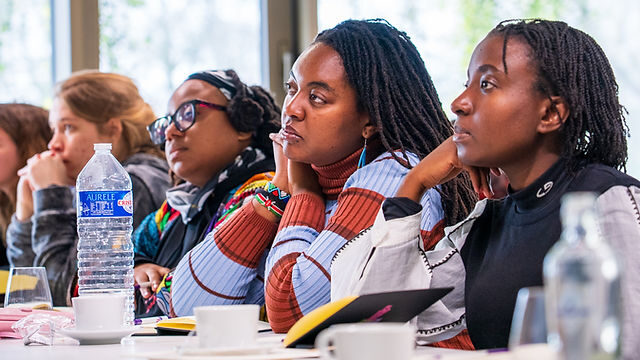
The Curricular Pillars: From Ethical Design to Paper Prototyping
The structural layout of the two-week, 80-hour training program is intentionally divided into two complementary operational phases, striking an intentional balance between high-level industrial masterclasses and practical, high-velocity development.
Week 1: Industrial Masterclasses & Studio Immersion
The introductory week centers heavily on technical, creative, and commercial exploration. Participants will undergo deep-dive technical workshops and masterclasses overseen by professional software engineers, 3D artists, and independent entrepreneurs. The curriculum encompasses worldbuilding, advanced programming practices, user interface (UI) and user experience (UX) architectural design, narrative structuring, and targeted business development and marketing frameworks tailored for indie studios.
A core highlight of the first week features specialized instruction led by Games for Change, a globally recognized pioneering organization that specializes in impact-driven game design. These sessions teach developers how to look beyond pure escapism or financial monetization models, showing them how to embed meaningful narratives that address real-world socio-political, environmental, and humanitarian challenges directly into their core loops. To ground this theoretical knowledge, the cohort will also embark on physical site visits to active game development studios across Flanders, offering a transparent look into professional European workflow systems.
Week 2: The Intercontinental Game Jam
The final phase shifts the cohort into a high-octane production crucible. Participants will be grouped into intercontinental teams, matching European and African developers to collaborate on building functional game prototypes from scratch.
Rather than focusing on standard commercial genres, the teams are tasked with responding to a specific ethical or social theme, drawing directly from their individual cultural backgrounds, personal identities, and lived regional experiences. The game jam challenges participants to tackle complex global realities, ranging from ecological sustainability and localized recycling systems to accessible urban public transit and social inclusion, and translate them into engaging mechanics. This practical framework ensures that developers exit the residency not just with refined theoretical insights, but with a collaborative, international portfolio piece to present to publishers.
Eligibility Requirements and Technical Profiles
To maintain a high standard of collaborative production during the intensive game jam phase, Howest has outlined specific, targeted parameters for prospective applicants. The initiative welcomes applications from cross-disciplinary backgrounds and spans multiple career tiers, explicitly encouraging applications from promising junior developers as well as established senior profiles looking to expand their international reach.
Candidates looking to secure a spot in the 2027 cohort must meet the following criteria:
- Regional Qualification: Applicants must be female-identifying game developers legally residing within South Africa, Kenya, Uganda, or Belgium.
- Professional Background: Candidates should hold a recognized degree, technical certification, or equivalent verified portfolio background in a gaming-adjacent field. Eligible disciplines include Computer Science, Interactive Media, Game Design, 3D Animation, Visual Effects (VFX), Digital Arts, and Sound Engineering.
- Industry Experience: A minimum of one year of active operational experience within the game development ecosystem is highly recommended. However, the selection committee explicitly notes that non-traditional paths, including intensive participation in independent hobbyist projects, community game jams, or documented self-taught development, are fully valid.
- Linguistic & Soft Skills: Because the program functions as a cross-cultural collaborative incubator, participants must demonstrate a minimum of B2-level proficiency in English alongside a highly collaborative, adaptable mindset.
From a technical toolset perspective, the program accommodates multiple development tracks. For technical artists and 3D animators, familiarity with industry-standard suites like Blender, Autodesk Maya, Z-Brush, 3DS Max, and Adobe Creative Cloud is highly valued, alongside operational familiarity with the Unity and Unreal engines. For gameplay and systems programmers, a solid foundational working knowledge of core languages such as C++, C#, Java, or Python is expected.
Funding Structure and Application Roadmap
Roots & Pixels operates as a heavily subsidized, fully funded international program designed to minimize economic access barriers for underrepresented creators. For the selected African cohort, the initiative covers comprehensive travel expenses, visa processing assistance, accommodation in Belgium, and institutional access to the DAE campus facilities throughout the two-week production lifecycle.
The digital application portal is currently processing international submissions from eligible African candidates. Applications remain open until 16 August 2026 at www.rootspixels.be, after which the selection committee will transition into portfolio evaluations, review motivation letters, and conduct remote interviews to finalize the intercontinental slots.
For independent creators looking to push their design limits, embed profound cultural narratives into modern mechanics, and permanently anchor themselves into an expanding global network of female tech leaders, this initiative represents a premier developmental milestone.