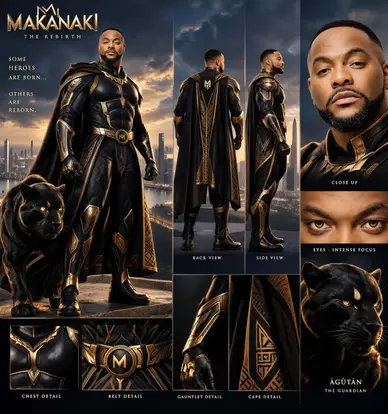
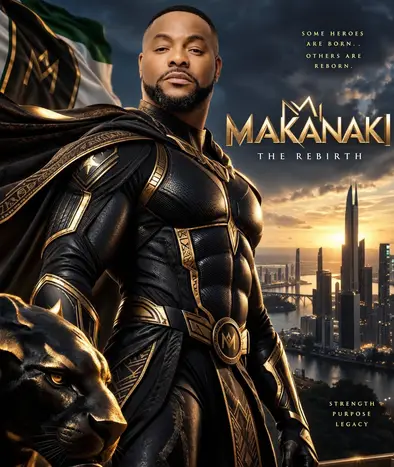
When Nollywood star Bolanle Ninalowo took to social media to showcase a teaser clip for Makanaki, The Rebirth, an upcoming superhero animated project created by his son Keyo, the comment sections immediately exploded with applause. On the surface, it looked like a classic feel-good story: a proud, successful father using his massive reach and financial influence to back his child’s creative ambition.
Look closer at the teaser, however, and a far more troubling reality emerges.
The preview exhibits the unmistakable hallmarks of generative artificial intelligence, morphing visual details, synthetic voice tracks, unnatural spatial motion, and telltale algorithmic frame blending. What was hyped as a young creator’s breakthrough entry into the animation world is, in truth, an AI-generated wrapper.
And that opens up a deeply uncomfortable, highly contentious debate across the African entertainment industry: when high-profile celebrities endorse generative AI as a quick shortcut to “making dreams come true,” what message does that send to the thousands of trained animators, visual effects artists, and voice actors fighting for survival in Nollywood?
A veteran actor of Ninalowo’s standing,someone who has spent years navigating the gritty realities of building a legitimate career in African entertainment, ought to know better.
The Mirage of Generative AI “Creativity”
It is easy to understand why an aspiring young creator would be tempted by text-to-video generators and prompt-based software. Traditional animation is notoriously demanding, slow, and expensive. Producing a standard 2D or 3D animated series requires an army of specialists: storyboard artists, concept designers, character modelers, riggers, lighting engineers, compositors, and voice talent. It demands years of formal study or grueling self-education, high-performance hardware, and substantial financial backing.
Generative AI bypasses that entire pipeline. With a few prompt strings and a monthly software subscription, virtually anyone can render a flashy pseudo-3D trailer in an afternoon.
The core issue, however, is that these software tools do not generate art out of thin air. Generative AI models are trained by scraping billions of copyrighted artworks, character designs, and animation frames from working human artists, almost always without consent, credit, or compensation.
When an established industry figure like Ninalowo parades an AI-generated teaser to millions of fans as a triumph of personal effort, he isn’t just celebrating his son. He is placing a massive celebrity stamp of approval on a technology built on extracted human labor. He is telling the public that software outputs derived from stolen artistic work are perfectly fine, provided the final clip looks shiny on a social media feed.
Job Losses in African Animation Are No Longer Theoretical
For years, tech evangelists insisted that AI would merely function as an assistant tool to help human artists speed up their workflow. But in 2026, the reality unfolding across creative hubs in Lagos, Johannesburg, and Nairobi is far more bleak.
Production companies seeking to slash overhead are quietly freezing junior artist roles, replacing storyboard departments with rapid prompt generation, and opting for synthesized voice outputs instead of hiring local voice actors. For Nigerian animators who spent years mastering complex digital software like Blender, Maya, and Toon Boom, this trend represents an existential threat to their livelihoods.
African animation was finally reaching an exciting, historic turning point. Original African stories were securing greenlights from international streaming platforms, proving that local studios could deliver world-class animation when properly funded.
When major industry figures champion cheap, automated outputs over hiring real human talent, they send a toxic signal to investors and studio executives: Why budget for a full team of young Nigerian artists when you can just prompt a machine for a fraction of the cost?
That line of thinking drains vital capital out of the local industry and shuts the door on entry-level jobs for talented young creators who don’t happen to have famous parents with deep pockets.
Privilege, Influence, and Public Responsibility
No one expects a father to withhold support from his child. Supporting a family is natural. But when you command a massive public platform, how you wield that influence matters.
Ninalowo has built a hugely respected personal brand around hard work, discipline, and earning one’s place in the industry. If his son is genuinely passionate about building a career in animation, the ultimate power move would have been using that celebrity clout to connect him with actual human animators, studio directors, and technical artists. Funding an actual production team would have created real jobs for young Nigerian creatives while teaching his son how to lead a genuine studio pipeline.
Promoting a prompt-generated clip does none of those things. It elevates a shortcut that directly displaces the very creative workforce that keeps Nollywood alive.
Nollywood Needs a Line in the Sand
The debate over generative AI in African media can no longer be brushed aside as a futuristic discussion. It is happening right now, and the choices made today by influential actors, studio heads, and executive producers will define the creative economy for the next decade.
If the African film and television industry permits generative AI to strip away human creative labor without pushback, we will wind up with a market that looks flashy on Instagram but offers zero sustainable career paths for human talent.
Nollywood was built on the grit, sweat, and raw brilliance of human storytellers. Replacing those people with machine prompts isn’t innovation, it’s exploitation. Celebrities who claim to care about the growth of African art need to start proving it, rather than applauding tools that actively take food off artists’ tables.