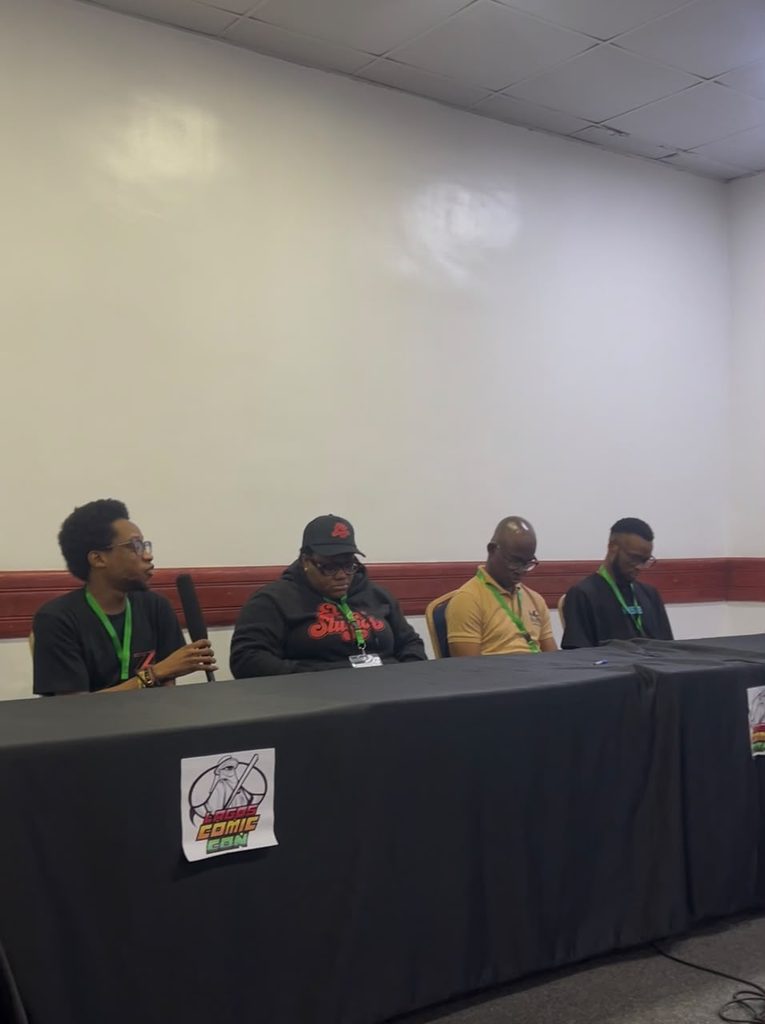
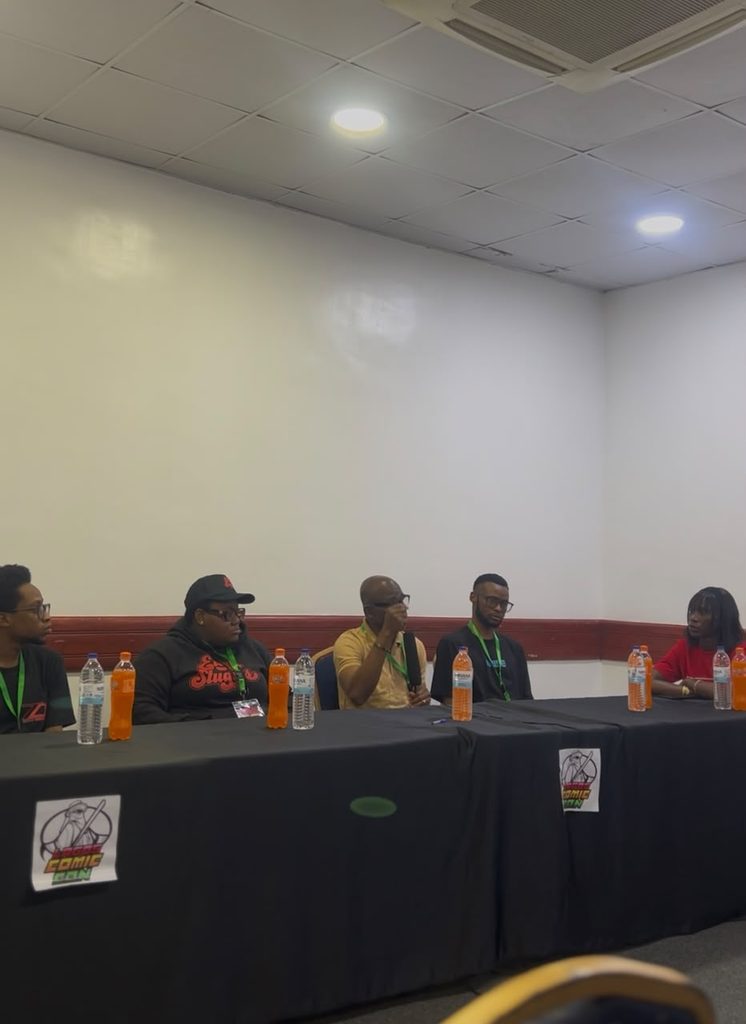
On the afternoon of September 12, 2026, inside the Landmark Event Center on Victoria Island, Lagos, four people sat down in the Comic Zone and did something that doesn’t happen enough at industry panels.
Outside, the convention was everything people had come to expect costumes, merchandise, art, creators, fans and the unmistakable excitement of a room full of people who love stories. But inside the Comic Zone, the conversation was about something less glamorous.
What does it actually take to build a comic industry in Africa? Not a celebration of what could be.
Not another conversation about how talented African creators are.
The real question was what happens after the talent, after the passion, after the first issue is released and the excitement fades.
ComicPanel moderated the third Comic Zone session, “The State of Comic Books in Africa,” bringing together four creators at very different points in their journeys: Oluwole Teniola Kamsi of Zadok Comics (Faith-based comics creator), Olabayo Enoch of Comican, Olayinka Henrietta Edun of Etta Studios, Mr. Kenneth Unamba of Majestic Comics
They did not arrive with one neat answer. They arrived with experience.
And, perhaps more importantly, they arrived with the willingness to talk about what usually gets left out of the success story.
Four Creators. Four Beginnings. One Difficult Reality.
The conversation began with a deceptively simple question: Why comics?
For Teniola Kamsi, the newest creator on the panel, the answer had nothing to do with market strategy or thoughts of building an industry.
He simply had a story he wanted to tell. He had started only the year before and created Heroes of Faith, a faith-based comic built around the kind of spiritual storytelling he felt was largely missing from the comics space.
“I just wanted to tell my stories,” he explained. “That’s why I started.”
Then people responded. Readers found the work. The story gained traction. And somewhere in that early response, the reality of what he had entered began to become clear.
For Kamsi, comics started with storytelling. But the moment other people began reading, the dream started acquiring responsibilities.
That was where Olabayo Enoch’s experience offered a sharp contrast.
He did not believe passion alone was enough to carry a creator through the realities of the industry. He loved comics, yes. But before committing himself fully, he wanted to understand the business behind them.
That distinction matters.
Because loving comics and building a sustainable comic business are two very different things.
And according to Enoch, creators who fail to understand the second part can find themselves leaving the industry before they have had enough time to build anything meaningful.
Henrietta Edun had taken almost the opposite route.
She started with passion. The kind of passion that makes you want to create before you’ve figured out how much everything will cost.
But passion, she admitted, eventually meets the bill.
“Passion is real,” she said, “but passion without bills being paid gets tiring.” That one sentence captured one of the uncomfortable realities of African comics.
A comic may begin with a writer and an idea, but it does not end there.
There is an artist to pay, colourist, printing, distribution, promotion.
And then, after all that, there is the next issue waiting to be made.
For Edun, the creative dream has often had to be financed by work outside the creative business itself. Her side job does not exist separately from her comics career; in many ways, it helps keep that career alive.
And then Kenneth Unamba put the entire conversation into perspective.
After nearly a decade of building Majestic Comics, he did not describe the African comics industry as a finished machine waiting for more people to join.
He described something still under construction.
“There is no comic industry yet. We are building the comic industry.”
It was probably the simplest statement of the afternoon. And also the one that explained almost everything that followed.
The Audience Is There. But How Big Is It?
There is movement. More creators are producing. More people are talking about African comics. More platforms are emerging.
More conventions are creating spaces where creators can meet readers, publishers, studios and other industry professionals.
But the panel refused to confuse the existence of a passionate community with the existence of a mass market.
Lagos Comic Con itself is proof that a community exists. Thousands of people can walk through a convention floor and spend an entire day celebrating comics, animation, gaming, film and pop culture.
But take the conversation outside that room.
Ask a random Nigerian to name a Nigerian comic character.
Ask them where they buy local comics.
Ask them to name three African comic creators.
That is where the gap becomes obvious.
The people who already know about African comics are highly engaged.
The challenge is reaching the people who don’t know they exist.
And that may be one of the industry’s biggest battles right now: visibility before monetisation.
You cannot build a large commercial audience from people who have never heard of you.
Then Comes the Problem
If there was one word that kept surfacing beneath the discussion, it was consistency.
Kenneth Unamba was particularly direct about it.
A creator releases Issue 1. The audience gets excited. People share it. Conversations begin.
Then Issue 2 takes too long.
By the time it arrives, the attention has moved elsewhere.
The audience has moved on.
The algorithm has moved on.
And the creator is effectively starting the climb again.
“Do better with releasing consistently,” Unamba urged.
It sounds simple.
It isn’t.
Consistency costs money, Consistency requires time.
Consistency requires a team that can actually keep producing when the excitement of the first release has disappeared.
That brings the conversation straight back to the problem creators had already identified: how do you keep creating when creating itself is expensive?
Why the Day Job Is Still Part of the Story
The panel was also asked about something many African creators quietly live with: the day job.
For many comic creators, their creative career does not yet pay enough to become their only career.
But should that be viewed as a failure?
Henrietta Edun offered another perspective.
She argued that the problem goes beyond the creators themselves. It is also rooted in how society understands creative careers.
For generations, many Nigerian parents have been more comfortable investing in conventional professions than in careers built around comics, art and storytelling.
And that perception has consequences.
When comics are treated as a hobby rather than a profession, it becomes harder for creators to secure the financial support, trust and resources needed to build them into sustainable businesses.
“Those stereotypes need to change,” Edun said. “People need to start seeing comics as a real thing that pays, and as a real career.”
Until that shift happens, the day job remains more than a backup plan.
For some creators, it is the investor.
The side job pays for the artist.
It pays for the next print run.
It pays for the colourist.
It pays for the story that would otherwise never make it to the page.
So perhaps the more useful question is not, “Why does this creator still have a day job?”
It is:
“How long can a creator continue funding an entire creative business alone?”
Piracy isn’t the Biggest Problem Yet
Then came piracy.
And surprisingly, the panel did not treat it as the monster many creators might expect.
The reason is uncomfortable.
You cannot worry too much about people stealing something that very few people know exists.
For an industry still fighting for visibility, obscurity can be a bigger threat than piracy.
All four panelists essentially arrived at the same conclusion: the industry needs to grow.
Get more people reading. Get more people buying.
Get more people talking about local comics. Build the audience.
Because when the industry becomes large enough for piracy to represent a serious financial threat, that will mean African comics have already crossed another important threshold.
In that sense, piracy may eventually become a problem worth having.
Why Are Creators Still Struggling?
This is where the optimism surrounding the growth of digital platforms meets the harder economics of creative work.
Today, creators have more potential routes to monetisation than previous generations had.
There is print.
There is digital publishing.
There is merchandise.
There is licensing.
There are international platforms.
There are webcomic platforms.
And there is Komikana, a Nigerian comics platform creating another avenue for creators to distribute their work directly to readers.
The infrastructure is growing.
The opportunities are expanding.
Yet many creators are still struggling financially.
Why?
Because having more places to sell a comic does not automatically create people willing to buy it.
And the panel’s discussion exposed the cycle clearly.
You need an audience to generate income.
You need income to produce consistently.
You need consistent production to keep the audience engaged.
And you often need money before you can build the systems that bring in more money.
That is the vicious circle.
The platforms are not the entire solution.
Neither is passion.
Neither is talent.
Building an industry requires creators who understand the business, audiences willing to support the work, cultural attitudes that take creative careers seriously, and systems that allow creators to keep producing long enough to grow.
The Advice Every New Creator Needs to Hear
By the time the conversation reached its final stretch, the question had changed.
It was no longer simply about what is wrong with African comics.
It became:
If you are just starting, knowing everything we know now, what should you do differently?
Kenneth Unamba’s answer began with a number.
1,000, That was how many copies Majestic Comics printed when they released their first title in 2017.
Almost a decade later, around 400 of those copies were still left.
It is an extraordinary statistic, but Unamba’s point was not that the comic had failed.
It was that the market moves differently from the imagination.
A creator can believe a thousand people are waiting for their story.
That does not mean a thousand people are ready to buy it.
So his advice to a new creator is simple, start small.
Do not spend money proving that you can produce at scale before you have proved that there is demand at scale.
Find your audience.
Test the market.
Understand what people are actually willing to pay for.
Then grow.
Henrietta Edun’s lesson followed naturally.
Passion can start the journey, but it cannot be the entire business plan.
Know what your comic costs.
Know what your artist costs.
Know what printing will cost.
Know what distribution will cost.
Understand your margins.
Understand where the money comes from and where it goes.
Because loving your story will make you want to finish it.
Understanding the business is what gives you a chance to make the next one.
Olabayo Enoch took the lesson beyond the individual creator.
Do not build alone.
For an industry still trying to establish itself, creators cannot afford to treat one another only as competitors.
Collaboration can mean sharing knowledge.
Cross-promoting one another’s work.
Connecting audiences.
Creating opportunities.
Learning from another creator’s mistakes instead of paying for the same lesson yourself.
A thriving community of creators is valuable.
But a connected community of creators can become something much bigger: an industry.
And then there was Teniola Kamsi.
The newest creator on the panel.
The person with the least amount of time in the room’s collective experience.
Tell your story.
The industry is still developing. The audience is still growing.
The infrastructure is still being built. The support systems are still evolving.
None of that changes the reason creators started in the first place.
There is a story inside you that only you can tell.
And if everyone waits for the industry to become perfect before they begin creating, the industry will never become what it could be.
Maybe That’s the Real State of African Comics
By 3pm, the session was over.
But the conversation in the Comic Zone had left behind something more useful than a neat conclusion.
It had exposed the contradictions.
African comics are growing, but the audience is still too small.
There are more platforms, but many creators still struggle to make money.
There is extraordinary creative talent, but consistency remains difficult.
Creators have stories worth telling, but many still have to finance those stories with income from somewhere else.
And perhaps most importantly, there is no finished industry waiting for the next generation to enter.
There are creators building one.
One issue at a time.
One reader at a time.
One collaboration at a time.
One risky print run at a time.
One story at a time.
That may be the most honest answer to the question posed that afternoon.
The state of African comics is unfinished.
But unfinished does not mean empty. It means there is still something being built.
And the people building it know exactly how difficult the work is.
Now, the question is whether enough people are ready to help them build it.
The conversation is better. The awareness is higher. The community is more connected. The events like this very panel at Lagos Comic Con are evidence of real industry infrastructure being built.
But industry doesn’t exist until it can sustain the people building it. Until an African comic creator can live off their comic, the building continues.
And from what was said in that room on September 12, 2026 the building is very much continuing.
Lagos Comic Con 2026 took place September 12–13 at the Landmark Event Center, Victoria Island, Lagos. The Comic Zone panel “The State of Comic Books in Africa” was moderated by ComicPanel.
What did you think of what was said? Drop your thoughts in the comments and share this with every comic creator who needs to hear that they’re not building alone.