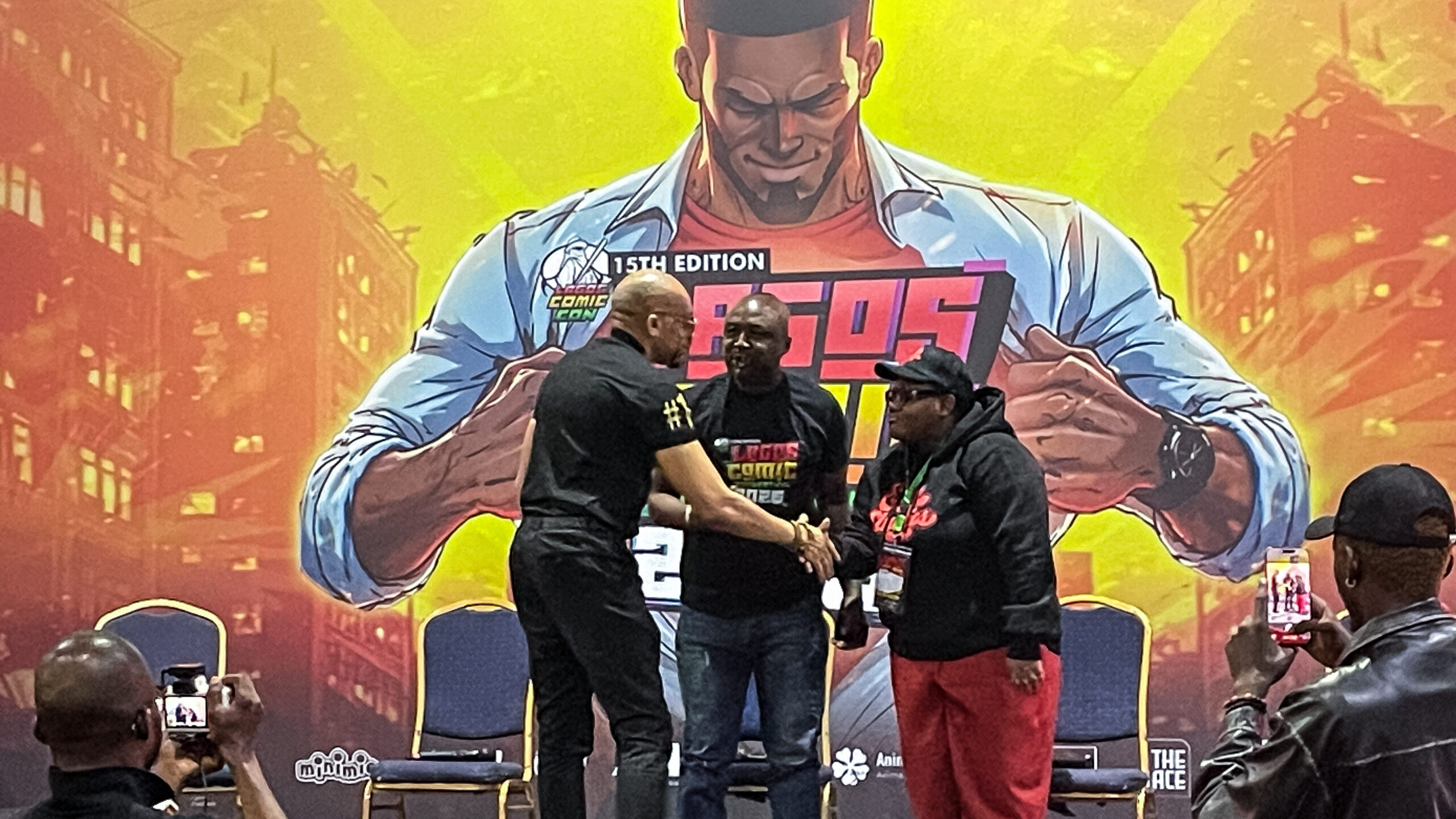
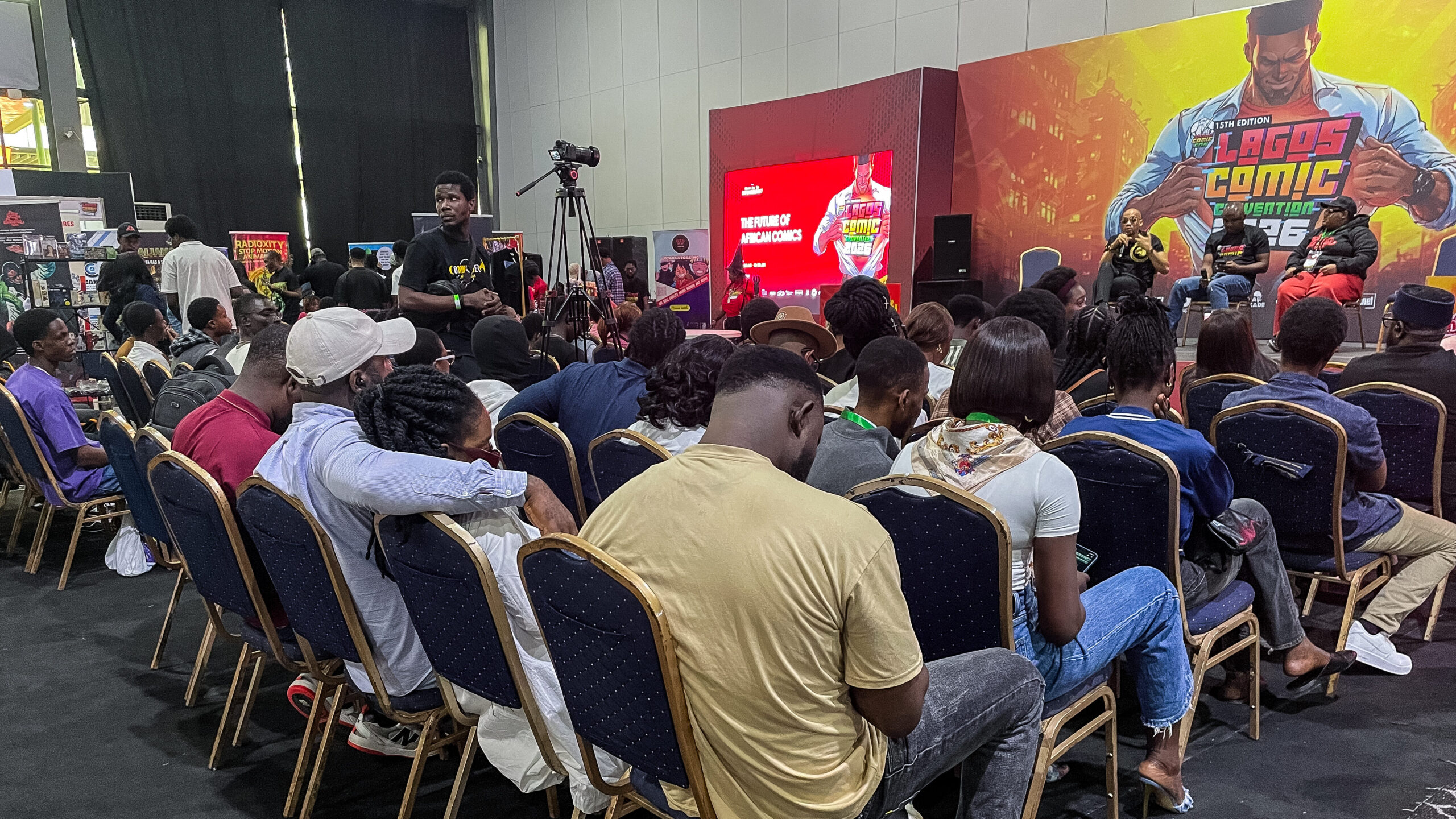
The future of African comics was the subject of a lively discussion at Lagos Comic Con 2026, where some of the people working in Nigeria’s creative industry looked at one of the biggest questions facing local comic creators: how does a growing comic scene become a strong and sustainable industry?
On the main stage, Mr. Jide Martin of Comic Republic, Ayodele Elegba and Olayinka Henrietta Edun of Etta Studio discussed the state of the Nigerian comic industry, the challenge of getting people to discover local characters and stories, and what creators need to do if they want their intellectual properties to reach wider audiences.
The conversation moved beyond the usual question of whether Nigerian creators can tell good stories. Instead, it focused on what happens after the story has been created.
How do creators find their audience? How do they turn characters into recognizable IP? And how long should a young industry expect to take before its properties become as widely known as the characters produced by major international comic companies?
These questions became central to the conversation.
Is Nigerian comics still in the early stages?
Ayodele Elegba opened one part of the discussion by asking Olayinka Henrietta Edun about her experience in the industry.
Edun, who has been building Etta Studio for several years, was asked whether she agreed with an earlier point made by Jide Martin about the development of the comic industry. Was the industry already moving forward, or was it still in what could be described as a seed stage?
Her answer was somewhere in between.
Edun said she both agreed and disagreed because, while the comic industry is becoming more known, there is still a large part of the Nigerian public that does not know it exists.
That lack of awareness remains one of the major challenges.
She explained that if you approached a random person in Nigeria and asked them to name a character from a Nigerian comic story, there is a good chance they would not be able to do so.
For someone working inside the comic community, that may seem surprising. But Edun’s point was that the people who attend comic conventions, follow animation and gaming, or actively search for pop-culture content are not necessarily representative of the wider Nigerian public.
There is a community, but the community still has to grow.
Edun also spoke about how she found that community herself.
Her interest began with anime, which she described as the starting point for her journey, just as it has been for many other fans. That interest eventually led her to Comic Con when the event was still being held in Ikeja.
It was there that she discovered something important: she was not alone.
There were other people with similar interests, and there was already a community forming around comics, anime and related forms of entertainment.
That experience also points to the role events can play in the growth of the industry. For someone who might feel like they are the only person interested in comics, walking into a convention and seeing hundreds or thousands of people with the same interests can change that perception.
But building a community of fans is only one part of the challenge.
The next question is how those fans become long-term readers and supporters of local intellectual properties.
From telling stories to building IP
Elegba then turned the discussion towards Jide Martins and the subject of intellectual property.
Martin has spent years building Comic Republic and its catalogue of characters, including Guardian Prime. Elegba asked him what creators with comic ideas should know about the terrain, particularly those who want to move beyond simply creating a comic book and build an IP that can become something much bigger.
The question also touched on a common idea among creators: “I just want to tell my story.”
Is telling the story enough?
Martin gave a direct response.
He disagreed with the suggestion that the level of awareness of Nigerian comics necessarily means the industry is behind where it should be. He described his position as coming from experience and used some of the biggest names in the global comic industry to explain his point.
He asked the audience how many people knew DC.
A large number of hands went up.
He then asked how many knew Marvel.
Again, many hands went up.
But when he moved to Image Comics and then ARC Comics, the number of raised hands dropped.
For Martin, the exercise demonstrated that the challenge of building awareness is not something that only Nigerian comic companies face.
There are established companies that have spent decades building their brands, characters and audiences.
Marvel and DC, for example, have had generations to develop their properties and become part of global popular culture. Nigerian comic companies are working with a much younger history.
Martin pointed out that Comic Republic is one of Nigeria’s oldest comic companies, but the company is still only around 15 years old.
That comparison was important to his argument.
A company does not automatically become globally recognized simply because it has created a good character. Recognition takes time, consistency and infrastructure.
He used Guardian Prime to bring the point closer to home.
While the character may be familiar to people who follow Nigerian comics, the level of recognition is still nowhere near the level of characters from the biggest international comic publishers.
But Martins’ argument was not that Nigerian creators should see that as a failure.
Instead, he believes the industry needs to give itself time to develop.
“We need to give ourselves the grace to actually grow,” he said.
A comic is more than the story
The discussion then moved into what Martins sees as another important part of building an IP.
Storytelling is necessary, but it is not the entire business.
According to Martins, Nigerian creators already know how to tell stories.
Nollywood tells stories. Comic creators tell stories. Game developers tell stories.
The next stage, in his view, is specialization.
That means developing the different parts of an industry that allow a creative property to grow beyond its original form.
A creator may come up with the character and write the story, but building a successful IP can involve marketing, legal work, publishing, licensing, distribution, branding and audience development.
Martins argued that creators should not feel that they have to handle every part of that process themselves.
He compared it with other professions where different specialists have specific roles.
The person who designs a building is not expected to also be the lawyer, marketer and every other professional involved in the project.
The same thinking, he suggested, needs to become more common in comics.
For an IP to grow, there needs to be an ecosystem around it.
This is an important distinction because having a character and having an IP business are not necessarily the same thing.
A creator can publish a comic and tell a story. But turning that story into an IP that can support merchandise, animation, games, licensing or other opportunities requires a different level of planning.
That is where Martins believes the Nigerian comic industry needs to move towards.
Finding the people who actually want your work
While Martin focused on the infrastructure needed to grow an IP, Edun brought the conversation back to one of the most basic parts of the process: finding the audience.
When Elegba asked what Etta Studio had been doing to make its comics and IPs more known among fans, Edun’s answer was simple.
Find your audience.
Creators need to know where the people interested in their work are and then go to those places.
For the Nigerian comic community, comic conventions and pop-culture events are an important part of that process.
Edun mentioned events such as Lagos Comic Con and Ibadan Fan Expo as places where creators can connect directly with people who are already interested in comics and related entertainment.
This is where events become more than just gatherings for fans.
They can serve as meeting points between creators and potential readers.
A creator may have spent months or years working on a comic without knowing exactly who is interested in it. At an event, that creator can put the work directly in front of people, hear their reactions and begin building relationships.
For a young comic industry, those relationships matter.
Awareness does not only come from advertising. It can also come from fans discovering a character, recommending it to someone else and returning for the next story.
That process takes time.
And as Edun’s comments suggested, the industry is still working on expanding that audience beyond the people who already know where to look.
What makes an IP lovable?
Elegba later asked Martin another important question: what is it about Comic Republic’s IPs that keeps people downloading, watching and reading them?
The answer returned to the issue of audience.
Martins explained that one of the things Comic Republic has tried to do is not simply look for people who already like what the company creates.
Instead, the company pays attention to what people like.
That difference can influence the way stories and characters are developed.
Rather than starting with the question, “What do we want to make?”, the process can also involve asking, “What does the audience want to see?”
Martins explained that this thinking is one reason Comic Republic has created a wide range of characters.
The company looks at the different genres that exist and considers what can be created for audiences with different interests.
It means the audience becomes part of the creative conversation.
Someone interested in one type of story may not necessarily be interested in another. A creator who understands that can develop different characters and concepts instead of assuming that one style will appeal to everyone.
“We create content for what they like,” Martin said.
That approach also connects back to Edun’s earlier point about finding an audience.
Knowing where your audience is matters.
But knowing what that audience actually wants matters too.
The role of comic conventions
One of the clearest points to come out of the discussion was the importance of events in growing the Nigerian comic ecosystem.
Lagos Comic Con itself is an example of a place where creators, fans, publishers, artists and other people working across the creative industry can meet.
For someone discovering Nigerian comics for the first time, an event can provide an entry point into a much bigger community.
That was part of Edun’s own experience.
Her journey started with anime before leading her towards Comic Con and eventually into the comic industry. The experience showed her that there were many other people interested in the same things.
That discovery is important for the growth of any creative community.
People need places where they can discover new work.
Creators need places where they can introduce their characters.
And fans need places where they can meet the people behind the stories they enjoy.
As more events develop across Nigeria, they can continue to play a role in connecting those different parts of the community.
Giving African comics room to grow
The discussion at Lagos Comic Con 2026 did not present one simple answer to the future of African comics.
Instead, it revealed several challenges that are connected.
There is the challenge of awareness. As Edun pointed out, many Nigerians still do not know that Nigerian comics exist.
There is the challenge of building recognizable IP. Martin’s comparison between younger Nigerian companies and established global publishers showed why local properties may need time to develop.
There is also the challenge of building the infrastructure around those properties.
And finally, there is the question of audience.
Who are the people reading these comics? Where can creators find them? What kinds of stories do they want? And how can creators turn those readers into long-term fans?
None of these questions can be solved overnight.
The global comic industry itself did not become what it is today in a few years. The companies that dominate the market have had decades to build characters, audiences and business structures.
For Nigerian and African creators, the task is now to build their own version of that ecosystem.
That does not mean simply copying Marvel or DC.
It means creating local characters, stories and businesses that can stand on their own while developing the professional structures needed to support them.
So, what is the future?
If there was one clear message from the conversation, it was that the future of African comics cannot depend on storytelling alone.
The stories matter. The characters matter. But so do the people who read them, the communities that support them and the businesses that help them grow.
Edun’s experience shows the importance of discovering and connecting with an existing audience.
Martin’s experience with Comic Republic shows the longer process of building an IP and the infrastructure around it.
Elegba’s questions brought both perspectives together, asking what creators can do today to make their work more visible tomorrow.
For the Nigerian comic industry, there is still plenty of room to grow.
There are audiences that have not discovered local comics yet. There are creators still developing their first characters. There are companies trying to build sustainable businesses around their stories.
And there are events like Lagos Comic Con providing a space for those creators and audiences to meet.
The future of African comics, then, may not be about waiting for one character or one company to suddenly become the next global phenomenon.
It may be about building an industry patiently, one creator, one reader, one event, one character and one IP at a time.
As Martin put it during the conversation, the industry needs to give itself the grace to grow.
For African comics, that growth is already underway. The bigger question is how far the industry can take it.