There’s a specific kind of dread that hits every comic creator eventually, you’ve built a character people actually love, a studio name people actually recognise, and somewhere in the back of your mind is the question you’ve been avoiding is any of this actually protected?
For most African comic and animation creators, the honest answer is no, not really. Not because anyone’s careless, but because nobody ever sat them down and explained how copyright, trademarks, or licensing actually work for people making original IP from scratch.
That gap is exactly what Project 1% for Africa was built to close and applications for the current cohort shut on 29 July 2026.
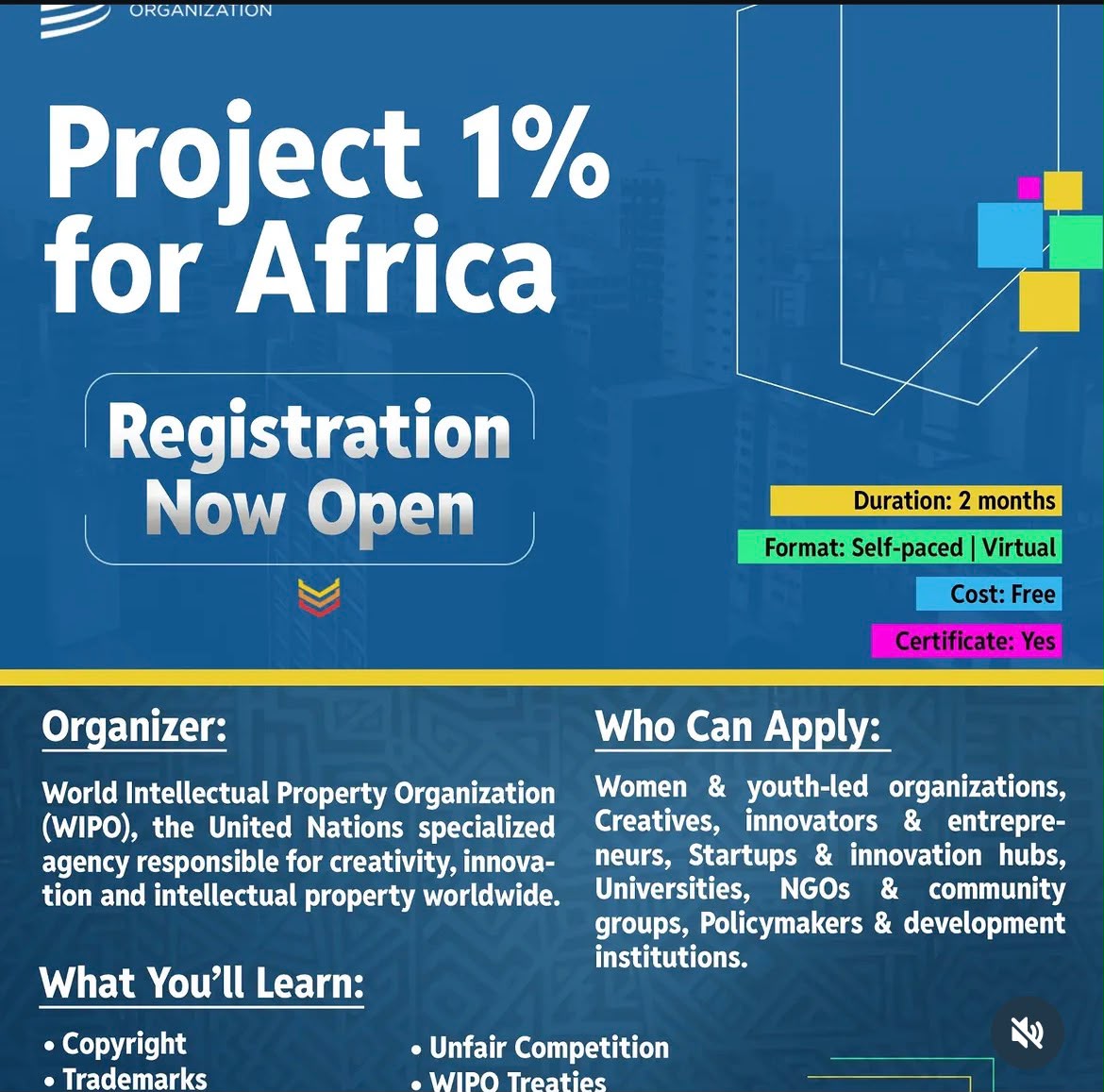
Project 1% is a free introductory intellectual property course run by the World Intellectual Property Organization’s Academy, and the name is literal: WIPO wants at least one percent of Africa’s population close to 14 million people equipped with foundational IP knowledge by 2030.
It’s a big number attached to a fairly quiet rollout, which is part of why so few creators seem to know it exists yet.
The programme is run by WIPO Academy’s IP eLearning Section, working with local institutions and WIPO’s external offices across the continent, and it’s open wider than the name might suggest founders, entrepreneurs, game developers, creatives, researchers, students, and business professionals all qualify. Enrolment is free, and it’s currently open at bit.ly/AccadeIP.
Here’s the part that makes it worth clearing your calendar for: successful applicants get roughly two months of self-paced online modules, topped up with live lectures from actual IP experts not a static video course you forget about after week one. It ends with an exam, and everyone who completes it walks away with a certificate that’s recognised internationally.
Score 90 percent or better, and WIPO fast-tracks you into a scholarship for an advanced Academy course, a real on-ramp for anyone who wants IP to become more than a side interest.
Thirteen modules make up the course, covering copyright and related rights in music and content creation, trademarks and industrial designs, patents, and traditional knowledge and cultural expressions, among others.
Line them up against the everyday habits of an African comic or animation creator, though, and the module list starts reading less like a syllabus and more like a mirror: a character posted online with no copyright registration behind it.
A studio name used for years before anyone checks whether it’s trademarked sometimes discovered too late, after someone bigger claims it first.
A story built on oral folklore or cultural heritage, published without any real understanding of how traditional cultural expressions fit into modern IP law. A licensing deal signed because it sounded reasonable, without anyone actually knowing which rights just left the building.
Piracy in African publishing isn’t a talking point, it’s a physical one. Nigeria’s Copyright Commission has raided printing houses in Ibadan, sealing them down and confiscating unauthorised print runs a blunt reminder that unresolved IP questions don’t stay abstract for long.
It also explains why WIPO is investing so visibly in the region right now.
The organisation opened its first Sub-Saharan Africa office in Abuja earlier this year, and Director General Daren Tang used a recent Nigeria visit to host a fireside chat built entirely around making IP work for creators bringing producers, policymakers, and digital innovators into one room to talk through what rights protection looks like in practice, not just in policy documents. Project 1% is essentially the training ground for that same conversation.
The growth curve here is hard to ignore. Project 1% launched in 2024 as a Nigeria-only pilot through a partnership between WIPO Academy and the WIPO Nigeria Office, reaching 1,598 participants 563 of whom scored high enough to earn advanced scholarships on the spot.
By 2025, it had expanded to 14 countries and roughly 2,100 participants, delivered in English, French, and Arabic across 39 partner institutions.
The most recent session, which wrapped with a virtual graduation in December 2025, pulled in more than 7,900 learners from 27 African countries, working through 96 partner institutions, including WIPO’s own offices in Nigeria and Algeria.
That’s not steady growth that’s a nearly fourfold jump in a single year, and it says a lot about how much appetite there is for exactly this kind of knowledge.
For comic book publishers, webtoon creators, animation studios, and the outlets covering them, a WIPO-certified grasp of copyright, trademark, and licensing isn’t a nice-to-have, it’s the missing infrastructure for an industry that’s still figuring out how to protect its own ideas before they scale, license characters across borders, or fight back against unauthorised reproduction.
Free, certified, and genuinely relevant is a rare combination in this space, and it won’t be on the table much longer.
Applications for the current Project 1% for Africa cohort close 29 July 2026. Free enrolment is open now .