There is no shortage of business books in the world.
Every year, thousands of them land on shelves padded with frameworks, buzzwords, and thinly veiled self-congratulation dressed up as wisdom. Most of them are forgotten within a year.
A few of them actually change how you think.
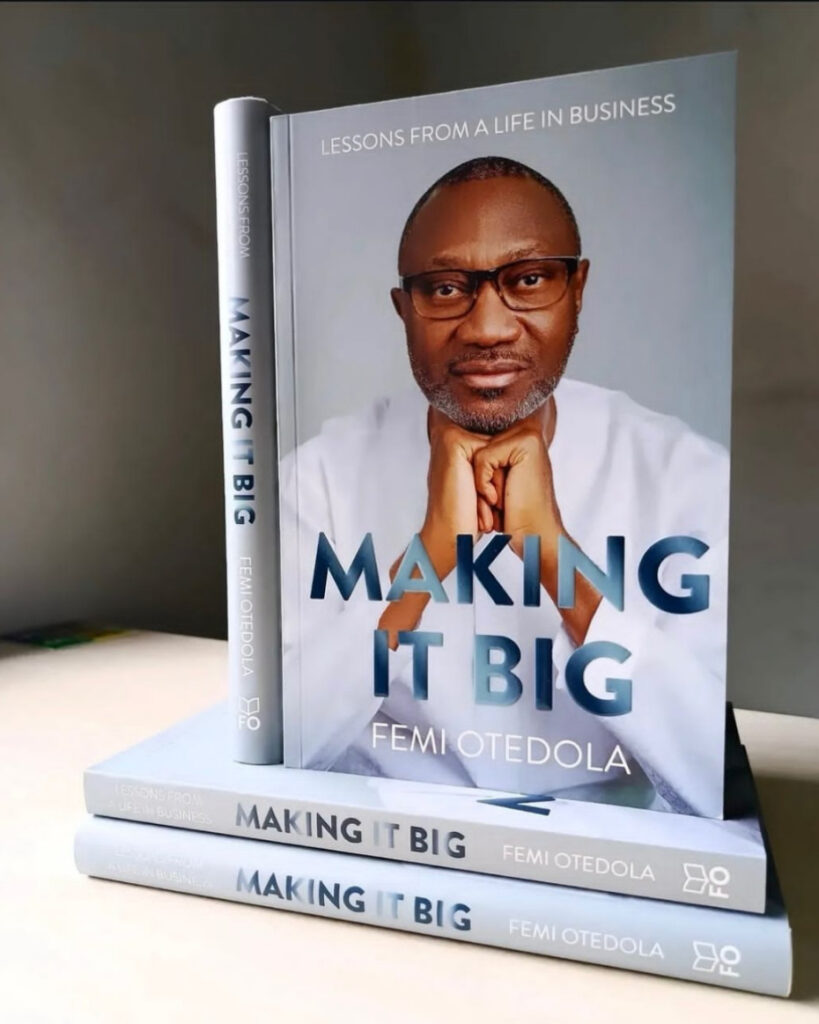
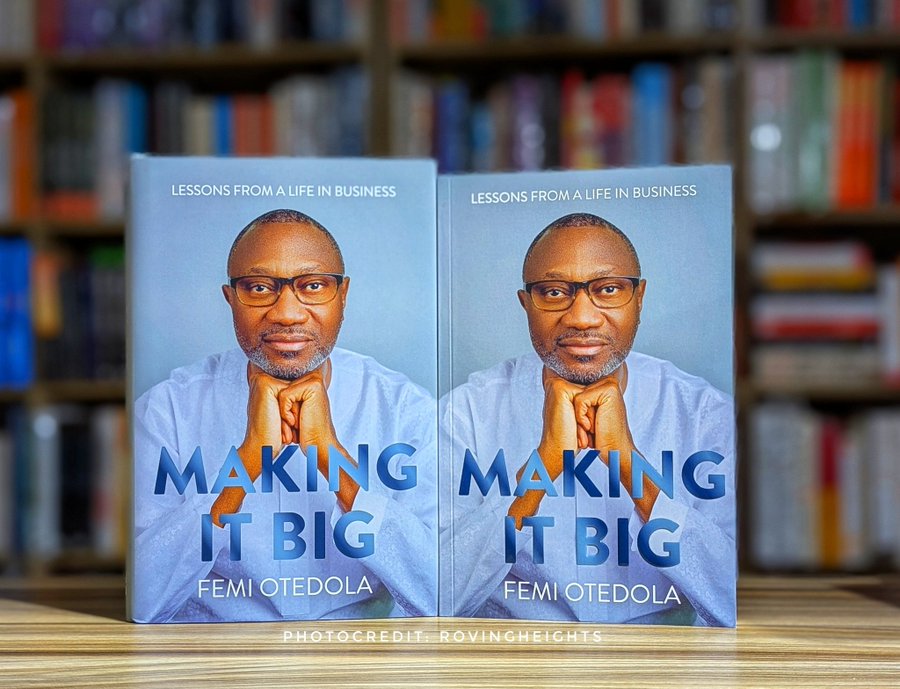
Making It Big: Lessons from a Life in Business by Femi Otedola belongs to that second category. Not because the writing is the most polished you’ll ever read.
But because the honesty in it is almost uncomfortable and in a landscape where African business leaders rarely document their real journeys at this depth, that honesty is genuinely rare.
This is the book Ngozi Okonjo-Iweala Director General of the World Trade Organization wrote the preface for. The book Aliko Dangote called “a highly recommended read for anyone who aspires to be successful in a challenging environment.”
The book the President of the African Development Bank described as “a must-read for all business leaders, policy makers and young people.”
When those three people agree on a book, you pay attention.
Who Is Femi Otedola and Why Does This Book Matter?
Femi Otedola is a Forbes-rated Nigerian billionaire, founder and former chairman of Forte Oil Plc, Executive Chairman of Geregu Power PLC, Chairman of FirstHoldCo PLC, and one of Nigeria’s most prominent philanthropists.
He made his first billion by 41. He lost over $1.3 billion in his mid-forties. And then he made it back.
That arc from billion to nothing to billion again, is the spine of this book. And it’s what makes it more than just another rich man’s memoir.
Making It Big was released on August 18, 2025 launched publicly in London and simultaneously available worldwide in hardcover, paperback, and digital formats. It took eight years to write.
That timeline matters: this isn’t a book written in a weekend of dictation to a ghostwriter. It’s a book Otedola genuinely sat with, thought through, and shaped into something he wanted to leave behind.
Title: Making It Big: Lessons from a Life in Business
Author: Femi Otedola
Published: August 18, 2025
Pages: 286–298 pages (hardcover)
Publisher: Narrative Landscape Press
Available: makingitbigbook.com, Waterstones UK, Book Peddler, and bookstores across Lagos, Nairobi, Accra
Where It Starts: A Boy With a Business Before He Could Spell One
The book opens with Otedola’s childhood and immediately reframes the “self-made” narrative in a way that is more honest than most. His father, Sir Michael Otedola, was a prominent Nigerian politician and businessman.
Otedola doesn’t hide this. He doesn’t use it as the whole story either. What comes through early is that Otedola was not a stellar student.
He struggled with formal education and acquired most of his real knowledge informally through apprenticeship with his father, through the company of educated people, and through reading obsessively.
That detail alone is worth the price of the book for anyone who has ever felt that traditional academic routes were not the only path.
He ran his first company Impact Press at 25. Then he spotted the opening that would define his career: Nigeria’s newly deregulated diesel market.
Through Zenon Petroleum, he eventually controlled a dominant share of Nigeria’s diesel supply, serving blue-chip clients and building a stake in Forte Oil that peaked above $1.2 billion in 2008.
The writing in these early sections has an energy to it, the late-night diesel cargo calls, the hustle of building in a market with no reliable infrastructure, the decisions made on instinct before frameworks existed.
One standout moment is a late-night diesel cargo call where a decisive action during a market downturn set the tone for how he would operate under pressure for the next two decades. It reads like a scene from a thriller because it essentially was one.
The Part Nobody Talks About: The Billion-Dollar Fall
This is where Making It Big separates itself from almost every other Nigerian business memoir.
Most people who write memoirs wait until everything is perfect until the comeback is complete and they can narrate the failure from the safety of success. Otedola does something braver. He goes inside the failure. He names it. He gives you the numbers.
By 2009, Otedola had accumulated ₦220 billion in debt across several banks.
AMCON (Asset Management Corporation of Nigeria) eventually acquired that debt for ₦140 billion resulting in an ₦80 billion haircut for the banks and significant personal asset losses for Otedola.
He lost more than $1.3 billion. The combination of weak risk management, excessive leverage, and the 2008 collapse in global crude oil prices created a perfect storm he could not outrun.
There is a moment in the book where he describes receiving a 2am phone call from President Olusegun Obasanjo, a tongue-lashing over the diesel deregulation crisis.
Reading that scene, you feel the pressure of operating at the intersection of business and politics in Nigeria, where the two can never be fully separated.
His response to the crisis? He stepped down as CEO. Not forced out, he chose to step aside, believing it was the only way to save what was left of his empire.
Arunma Oteh, former Director General of the Securities and Exchange Commission, praises this section specifically for its brutal honesty calling it a masterclass in choosing survival over ego.
“Making It Big is rare for its candor and useful for its specifics.
It argues, convincingly, that transparency about failure is a competitive advantage and that African business narratives are strongest when they trade polish for truth.”
The Comeback and the Lessons That Actually Hold Up
The rebuild section of the book is where the business lessons get most practical. After losing everything, Otedola pivoted, into power through Geregu Power PLC, into banking through FirstHoldCo, into real estate, and into a role as one of Nigeria’s most active philanthropists.
Three lessons from this section stand out across multiple reviews and are worth pulling out directly:
- Debt is a tool, not a lifeline. Otedola’s Zenon experience is a case study in what happens when leverage meets a volatile market without adequate risk management. Growing a business without debt is almost impossible but debt without a clear repayment plan and exit strategy can destroy what years of work built in months.
- Hire people who can do what you cannot. One of the most quoted lines in the book is about Akin Akinfemiwa — the CEO who helped transform Forte Oil into a world-class company. “My best recruitment ever,” Otedola calls him. The lesson: an entrepreneur’s job is to spot opportunities, but scaling requires people who can execute what you can only vision. Integrity and honesty are the non-negotiable qualities he looks for and he describes letting people go the moment those standards are broken.
- Mindset is infrastructure. The recurring theme across every chapter is that Otedola’s confidence and discipline carried him further than his connections or his capital. His belief that losing a billion is not the end that it is data, not defeat is the philosophy that enabled the comeback. It sounds like a motivational poster until you see the numbers that back it up.
The Philanthropy Chapter: Where It Gets Genuinely Moving
Many business books treat philanthropy as an afterthought, a final chapter that serves as reputation management. Otedola’s book is different here too.
In 2019, he donated $14 million to Save the Children UK specifically targeting education and healthcare for children in conflict-affected areas of northeast Nigeria.
He is the Chancellor of Augustine University in Epe. He was appointed a Vice-President of Save the Children in 2021.
He was awarded the Commander of the Order of the Niger (CON) in 2010 by the Nigerian government.
What the book makes clear is that none of this is optics. Otedola’s position is explicit: philanthropy is not the reward for success, it is a strategy for building something that outlasts you.
Education as infrastructure. Healthcare as investment. The legacy chapter is where the book graduates from business memoir to something with more weight.
What the Book Gets Right And One Fair Criticism
The book’s greatest strength is its willingness to be specific. Numbers, names, real decisions with real consequences, this is not a vague recollection of “challenges I overcame.”
It is a documented record of exactly what went wrong and exactly what Otedola did about it.
One Medium reviewer compared it to “a front-row ticket to the high-stakes circus of African entrepreneurship” and that description is accurate.
The book moves fast, covers a lot of ground, and never lets you forget you’re reading about someone who operated at the intersection of business, politics, and national infrastructure in one of the world’s most complex environments.
The one fair criticism worth noting: as one reviewer pointed out, Otedola acknowledges the role of political relationships and institutional access in his journey but the book doesn’t always dwell on how that access shaped outcomes in ways that wouldn’t be replicable for someone without his surname or his father’s network.
That’s not a reason not to read it. It’s just a reminder to take the most transferable lessons mindset, hiring, debt management, reinvention and apply them in your own context.
Who Should Read This Book?
- Young Nigerian and African entrepreneurs who need proof that setbacks aren’t terminal especially those building in volatile, underdeveloped markets where the odds are structurally against them
- Business leaders and executives who want a real case study in crisis management, not a sanitised corporate narrative
- Policy makers who would benefit from understanding how large-scale business decisions interact with Nigerian economic policy and regulation
- Anyone who has ever lost something significant a job, a company, money and needs to see what “starting over” actually looks like when done with discipline and without self-pity
Making It Big: Lessons from a Life in Business is available worldwide at makingitbigbook.com, in hardcover and paperback. In Nigeria, find it in leading bookstores across Lagos, Abuja, and Port Harcourt. In the UK, available at Waterstones.
Have you read Making It Big? Which lesson hit hardest for you? Drop your thoughts in the comments and share this with someone who needs to read it.