If you have spent any time on local tech circles, social media feeds, or community gaming groups over the past week, you have almost certainly seen the screenshots: pixelated avatars hanging out in virtual spots, driving iconic yellow buses, chatting, and recreating the daily energy of commercial Lagos.
What started as an ambitious indie project inspired by The Sims has erupted into a full-blown viral gaming movement.
When creator Shalom Rayhamen (also known as Shalom Mathew online or @shalom_heyeliy on X) first revealed the project, early platform metrics showed Lagos Life hitting 100,000 registered users with around 11,000 players active at the same time. Within days, that initial spark turned into a massive wave.
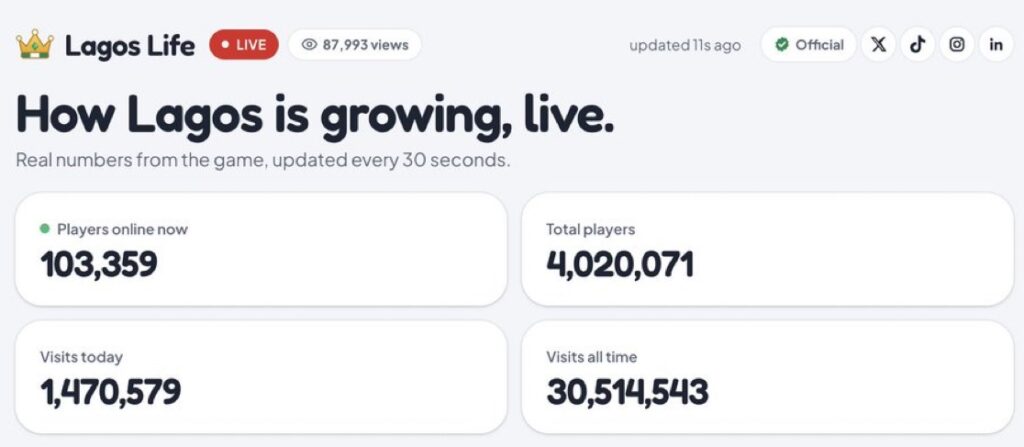
As the game expanded its server capacity, concurrent player counts blew past 50,000 simultaneous users, passed 2m players earlier this week and brought in nearly $50,000 in revenue for the team, showing how quickly its player base and commercial engine were moving.
Now, live dashboard updates shared by Rayhamen on X confirm that the platform has officially surpassed 4 million registered players (sitting at 4,020,071 total users), maintaining over 103,000 players online simultaneously, recording 1.47 million daily visits, and blowing past 30.5 million total all-time visits.
For a sandbox title built by an independent creator, generating tens of thousands of dollars and pulling millions of users in under a week is virtually unheard of in the regional landscape. To understand how the game reached this milestone, read our earlier coverage on inside the Lagos Life phenomenon: how a simple browser game captured over 1 million players and reshaped African gaming.
The Spark: From The Sims to Lagos Run
The backstory behind Lagos Life is rooted in creative inspiration and community momentum.
Rayhamen initially conceived the idea after playing life simulation classics like The Sims 3, wondering why there were almost no mainstream virtual sandbox worlds built around African culture, architecture, slang, and social dynamics. While traditional life simulators force players into North American suburbs or European towns, the desire for a game where players could navigate local spaces was always sitting right under the surface.
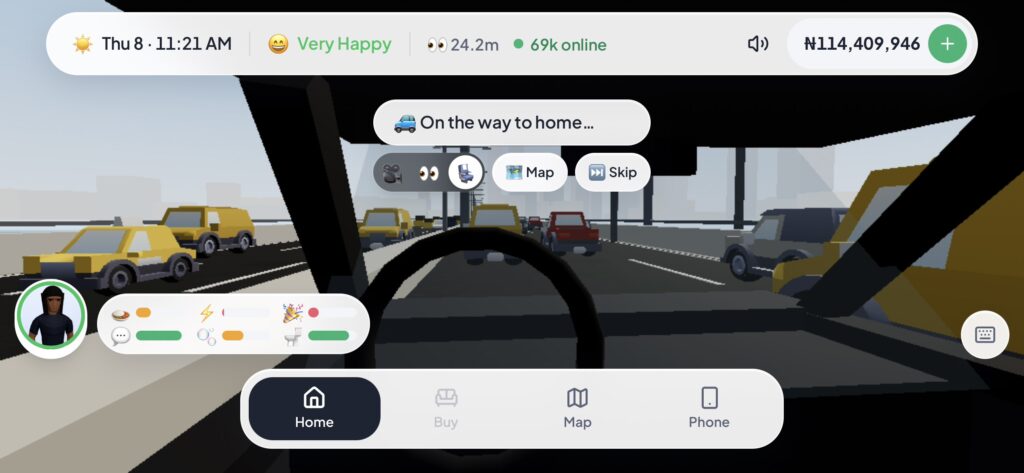
The turning point came when fellow independent developer Eureka released Lagos Run, a lightweight browser game where players navigate a traditional yellow danfo bus through chaotic city traffic. Seeing Lagos Run rack up over 85,000 players in its first week proved a crucial concept: local gamers were hungry for interactive experiences that mirrored their real-world environment.
Inspired by that success, Rayhamen set out to build a broader social world where players could do more than just drive, they could live, customize characters, meet new friends, build spaces, and hang out online.
- Initial Concept: Social Life-Sim inspired by The Sims 3 tailored for West African youth culture.
- Early Launch Milestone: 100,000 Registered Users / 11,000 Peak Concurrent Players.
- Rapid Expansion Phase: 2 Million Players / Nearly $50,000 Revenue.
- 4 Million Scale: 4.02 Million+ Total Players / 103k+ Live Concurrent / 30.5 Million+ Visits.
- Platform Access: Web Browser (No Download / No High-End Hardware Specs Required).
Why the Browser Model Won Big
In modern gaming, developer focus usually leans heavily toward high-end console releases or heavy PC downloads built on complex engines. But in emerging markets across West Africa, that traditional approach introduces major friction points:
- Expensive Hardware Requirements: High-end gaming consoles and dedicated graphics cards remain costly for everyday consumers.
- Data and Download Friction: Multi-gigabyte downloads consume significant internet data and take hours on unstable mobile connections.
- Storage Space Limits: Mobile devices and entry-level laptops frequently lack storage space for massive game files.
Lagos Life bypassed every single one of those barriers by launching directly as an instant browser game.
Players do not need a high-end PC, a modern console, or a 50GB installation file. You simply click a link, load the site in seconds on a basic phone or laptop browser, create an avatar, and jump straight into the city.
By removing the initial barrier to entry, the game opened its doors to a massive audience that traditional releases completely miss: casual players, students, tech workers, and people who would never classify themselves as “hardcore gamers”.
What Actually Happens Inside the City?
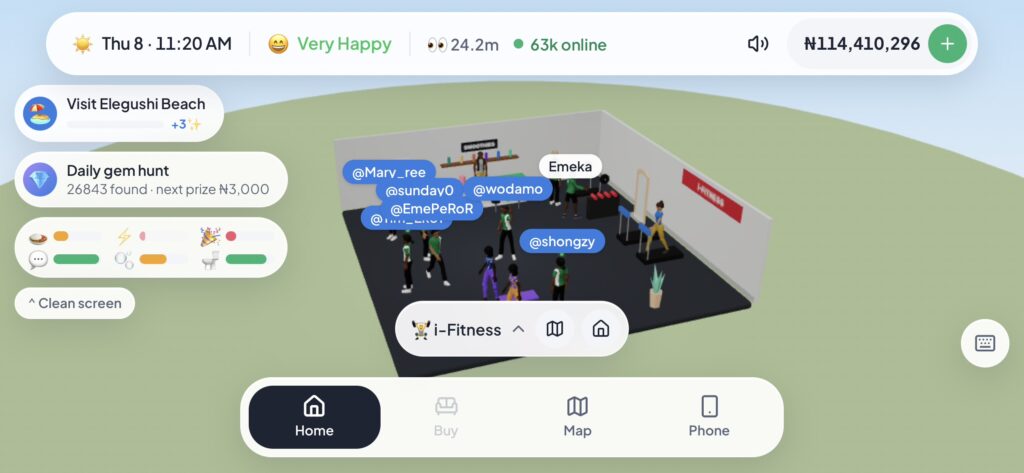
At its core, Lagos Life works as a social sandbox world. When you log in, you enter a virtual representation of Lagos filled with thousands of other real players moving around in real time.
- Avatar Creation: Custom outfits, street wear, traditional styles, and cultural flair.
- Exploration & Jobs: Drive danfo buses, trade, run street stalls, get jobs, rent homes, and earn virtual naira.
- Social Hangouts: Open voice and text chat, group parties, player communities, and spontaneous events.
- Cultural Customization: Avatars feature local fashion choices, everyday street wear, traditional outfits, and familiar hairstyles that resonate with local youth culture.
- Organic Social Hubs: Players gather in virtual spots to chat, hold impromptu parties, stream music, make jokes, and hang out after work or school.
- Local Micro-Economies: The game incorporates familiar city dynamics, from hustling and managing virtual naira to navigating recognizable local spots like Amala Shitta or Quilox.
Because the environment is built around shared cultural references, the interactions feel authentic. Players are not trying to fit into a foreign gaming culture; they are using familiar slang, sharing local humor, and building communities in a space that feels like home.
What This Means for the African Gaming Industry
The rapid rise, 4-million-player milestone, and four-figure daily revenue streams of Lagos Life carry huge implications for game developers across the continent.
For years, the standard narrative around African gaming focused on the difficulty of finding local monetization or reaching large player bases without heavy international backing. Lagos Life proves that when a product is accessible, culturally relevant, and fun, the audience and the financial sustainability are already waiting.
- Lagos Life Core: Active Platform (4m+ Players, 30.5m Visits, In-Game Advertising and Item Sales).
- Abuja Life: In Active Development (Focused on Capital City Layout and Regional Landmarks).
- Port Harcourt Life: In Early Planning (Coastal City Mechanics and Connected Airports).
Following the success of the Lagos server, Rayhamen confirmed that plans are already underway to expand the ecosystem into new virtual cities, including Abuja Life and Port Harcourt Life, complete with connecting virtual airports. This hints at a broader vision: building an interconnected network of virtual African cities where players can travel between regions, trade goods, and build localized digital lives.
The Road Ahead
Maintaining a live-service browser game that suddenly grows from a few thousand users to over 103,000 concurrent players and 4 million total users in under a week is no small task. Scaling server architecture, preventing lag, managing community moderation, and adding fresh gameplay loops will require continuous work from the development team.
Yet, whatever comes next, Lagos Life has already fundamentally shifted the conversation. It has shown that web-based, friction-free gaming is a powerful distribution model for emerging markets, and that African gamers are eager to see their own cities, stories, and social dynamics immortalized in interactive form.
As Rayhamen noted when celebrating these live milestones, the platform is evolving into “a whole movement”. If the past week and its 30.5 million visit numbers are any indication, the virtual streets of Lagos Life are going to stay busy for a long time to come.