Niyi Akinmolayan and his team at Anthill Studios have never been afraid of taking massive swings. Whether you look back at past projects like The Wedding Party 2 or the high-stakes historical scope of Lisabi, Akinmolayan consistently tries to push the boundary of what Nigerian cinema can look like on the big screen. With Colours of Fire, the goal was even bigger: establishing a brand-new cinematic language dubbed “Afrofusion,” blending traditional Yoruba myth, pan-African fashion, heavy CGI, and cutting-edge generative AI.
It is an admirable mission. We all want to see Nollywood stand side by side with Hollywood blockbusters, competing on scale, visual grandeur, and world-building. However, sitting through Colours of Fire, you realize very quickly that ambition alone cannot carry a two-hour fantasy epic if the technology gets in the way of the storytelling.
The film lands as a deeply intriguing, visually ambitious, but ultimately mixed bag. Let’s break down the good, the bad, and the ugly of Anthill’s latest spectacle.
A story about more than tribes and magic
At the centre of Colours of Fire is Akinbode, a warrior sent to hunt a beast believed to have been unleashed by a rival clan. What begins as a mission to kill a supposed enemy gradually becomes a journey into a much bigger truth.
The two sides have spent generations believing that the other is responsible for their suffering. Fear has become tradition. Rumours have become history. And hatred has become something that is passed down.
When Akinbode encounters Moremi, the mission changes.
Their relationship becomes more than a love story. It becomes a bridge between two groups that have been taught to see each other as enemies.
That is one of the strongest parts of the film.
The Blue and Red tribes are not simply there to give the movie different colours. They represent opposing ideas. The Blue Tribe represents an established order and traditions that have become difficult to challenge, while the Red Tribe represents change, disruption and something that threatens that old order.
Akinbode and Moremi represent the younger generation caught between these worlds.
That gives Colours of Fire a surprisingly relevant theme.
The real enemy is not necessarily the person standing on the other side. Sometimes, the real enemy is the story people have been told about that person.
It is a simple idea, but the movie gives it a large mythological setting.
The Good: Electric Chemistry and Groundbreaking Action
When Colours of Fire strips away the digital clutter and focuses on human performance, it genuinely shines. The absolute beating heart of this entire movie is the relationship between Akinbode (played with grounded intensity by Uzor Arukwe) and Moremi (brought to life by Osas Ighodaro).
The plot centers on two warring factions: the Blue Tribe, who hold power through sacred fabric-making magic known as Elu, and the Red Tribe, who are demonized through centuries of propaganda and inherited myths. Sent to hunt down a monstrous threat allegedly unleashed by the Reds, Akinbode instead encounters Moremi. What follows isn’t a gory creature feature, but a quiet, compelling romantic dynamic built on unlearning prejudice. The spark between Arukwe and Ighodaro feels real, carrying an emotional weight that keeps you invested even when the surrounding plot starts to stumble.
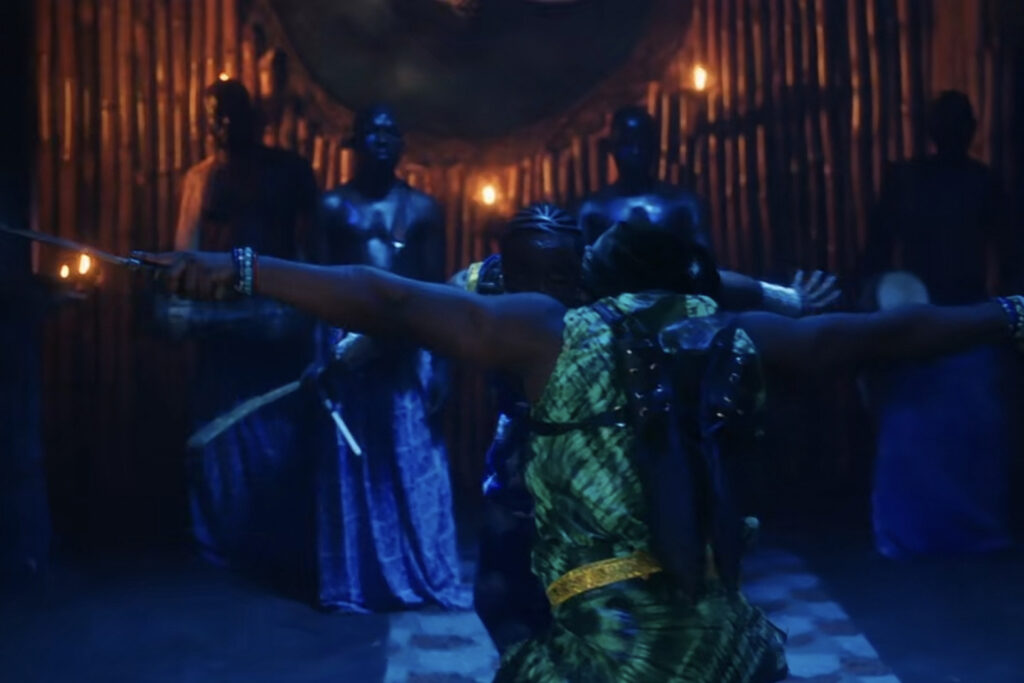
Then there are the fight scenes. Nigerian action cinema has come a remarkably long way, and Akinmolayan proves once again that local directors can stage thrilling, heavy-hitting choreography. The physical face-off between Akinbode and Badero (Gabriel Afolayan) is an absolute standout. The stunt work feels tactile, heavy, and dangerous. Weapons clash with weight, the footwork is precise, and the camera knows exactly when to hold back and let the physical performers showcase their craft without relying on rapid-fire editing cuts. When the movie trusts its actors and stunt team to handle the drama and physical combat directly, it achieves a high-water mark for modern Nollywood action.

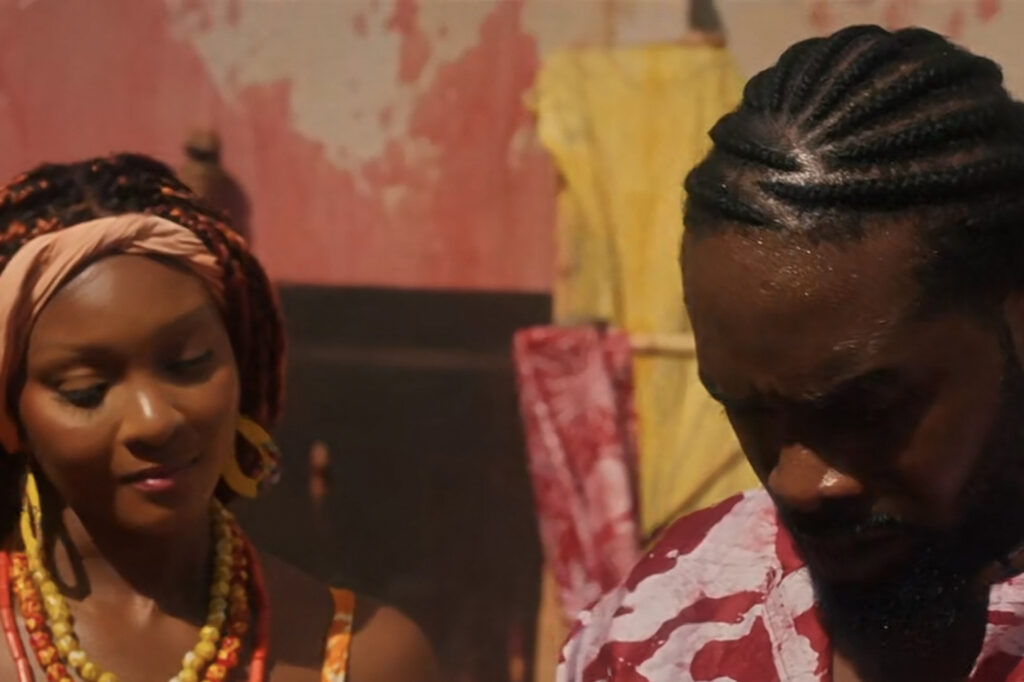
Furthermore, the physical production design, wardrobe, and musical score deserve real credit. The costume department crafted intricate, color-coded outfits that immediately tell you everything about a character’s social hierarchy, tribal roots, and political leaning long before a line of dialogue is spoken. Paired with a theatrical, drum-heavy musical score composed by Oludamilola Adewale Aluko, the film creates moments of genuine mythic wonder.


The Bad: VFX Overload and Unconvincing Magic
Where the film begins to lose its footing is in its heavy-handed reliance on visual effects. Having big ideas for magical systems in a fantasy world is fine, but those effects need to feel integrated into the environment rather than pasted over the top of live footage.
Throughout Colours of Fire, the digital effects are simply too obvious and glaringly artificial. Instead of enhancing the narrative, the constant clouds of digital dust, glowing energy overlays, and green-screen background extensions constantly pull you out of the experience.
Take the character of Efunsetan (played by Mercy Aigbe). Her character wields formidable magical powers that should feel terrifying and reverent within the story’s lore. On screen, however, the digital execution of her magic looks raw and unpolished. The energy bolts and mystical aura lack physical interaction with the actors and the surrounding physical set, making crucial confrontation scenes feel more like a video game cutscene than a high-stakes cinematic climax. Rather than feeling awe at her strength, you find yourself staring at the digital outline around the character, noticing where the live plate ends and the CGI begins.


The Ugly: Over-Reliance on Obvious AI Generative Visuals
The most frustrating aspect of Colours of Fire, and the element that ultimately hurts the movie’s pacing, is its excessive use of AI-generated visuals.
We know what Niyi Akinmolayan and Anthill Studios were aiming for here. Trying to think out of the box, experiment with modern tech tools, and bypass the massive financial limitations that usually hold African fantasy back is a noble attempt. In Hollywood, massive budgets allow studios to physically build massive practical sets or spend hundreds of millions of dollars on seamless digital environment rendering. Anthill tried to bridge that gap using generative AI tools to build wide shots, mythical cityscapes, and grand architectural backdrops.
The execution, unfortunately, lands squarely in the cringe category.
The AI-generated buildings, structures, and grand environment sweeps look conspicuously out of place. They lack weight, texture, consistent lighting, and structural logic. Rather than looking like a real, lived-in ancient African civilization, the background art often resembles glossy digital concept art or a still image generated from a prompt that was dropped right into the middle of a scene.
Worse, these sequences linger for far too long. Instead of quick establishing shots to set the mood, the film repeatedly pauses to show off these AI landscapes. Because the visuals feel fake and disjointed from the physical actors walking in front of green screens, these moments become boring. They break the immersion so badly that you almost want to fast-forward through the grand city reveals just to get back to the actual human actors performing on practical sets.


The Verdict: A Bold Milestone That Needs More Story Craft
Colours of Fire is a classic case of a film where the technical ambition outpaces the actual execution. It deserves respect for refusing to play it safe, for attempting to carve out an “Afrofusion” genre, and for proving that Nigerian fight directors can deliver world-class physical action. The chemistry between Uzor Arukwe and Osas Ighodaro proves that the emotional core of Nollywood is as strong as ever.
However, throwing every new software tool, green-screen layer, and AI prompt at the screen doesn’t make a film feel bigger; it just makes it feel cluttered. Moving forward, Anthill Studios and other Nollywood filmmakers would do well to remember that practical sets, strong character writing, and restraint always beat flashy digital shortcuts.
If you love Nigerian cinema and want to see the industry push its boundaries, Colours of Fire is worth a watch for its performance moments and epic fights. Just be prepared to cringe through a few artificial buildings along the way.
Colours of Fire is a classic case of a film where the technical ambition outpaces the actual execution. It deserves respect for refusing to play it safe, for attempting to carve out an “Afrofusion” genre, and for proving that Nigerian fight directors can deliver world-class physical action. The chemistry between Uzor Arukwe and Osas Ighodaro proves that the emotional core of Nollywood is as strong as ever.
However, throwing every new software tool, green-screen layer, and AI prompt at the screen doesn’t make a film feel bigger; it just makes it feel cluttered. Moving forward, Anthill Studios and other Nollywood filmmakers would do well to remember that practical sets, strong character writing, and restraint always beat flashy digital shortcuts.
If you love Nigerian cinema and want to see the industry push its boundaries, Colours of Fire is worth a watch for its performance moments and epic fights. Just be prepared to cringe through a few artificial buildings along the way.
For those who haven’t seen the movie yet and want to judge the visuals for themselves, Colours of Fire is currently streaming on Netflix.